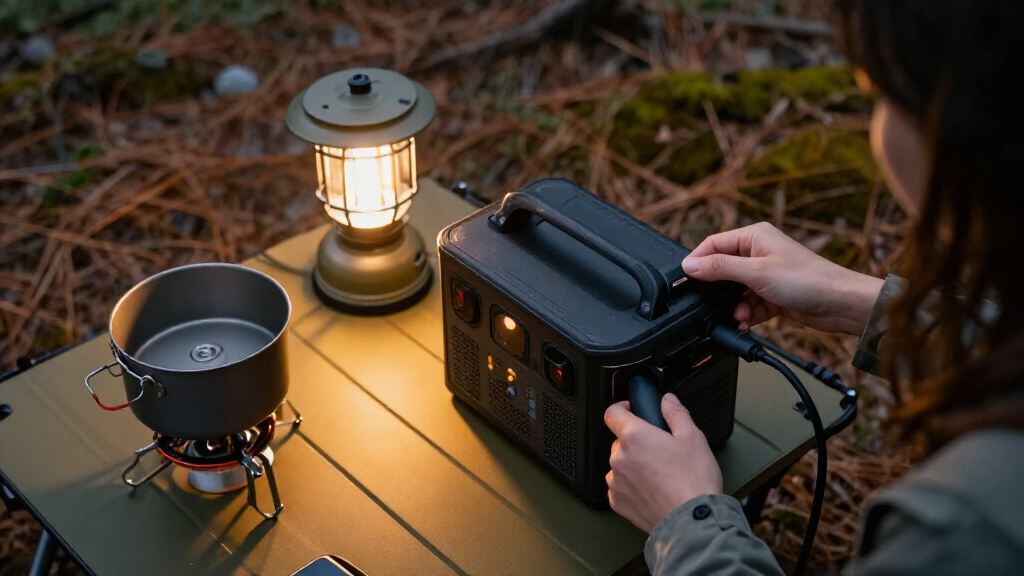

For most campers, I’d start with the Anker SOLIX C1000: its 1,056Wh capacity and higher output suit longer trips and a wider range of gear than compact units. The Jackery Explorer 300 is a simpler fit for light charging, while the BLUETTI Elite 100 V2 offers more output for campers bringing power-hungry devices. The main tradeoff is straightforward: larger stations can run more equipment for longer, but take up more space and are less convenient to carry. Smaller models pack easily, though their limited capacity calls for careful load planning. Read on for the full breakdown of all 15 options and how I’d match them to different camping needs.

Get travel and outdoor gear delivered free with Prime
- Fast, free delivery on millions of items
- Prime Video, Amazon Music and more included
- Member-only deals all year
Complete the kit


Key Takeaways
- The C1000 is the most flexible all-around pick: its 1,056Wh capacity makes it a stronger base for multi-device trips than the 288–330Wh compact group.
- Capacity and output solve different problems: the Jackery Explorer 1000 v2 and BLUETTI Elite 100 V2 offer over 1,000Wh, while the Elite 100 V2 has the higher listed output at 1,800W.
- Compact stations suit light loads, not every campsite: models around 88–330Wh are better for phones, lights, and small electronics than extended use of higher-draw appliances.
- LiFePO4 appears across both ends of the size range: the Daran 89.6Wh and DYNESS 256Wh show that battery chemistry alone does not tell you how much gear a station can support.
- The Anker SOLIX C300 and C300 DC are not interchangeable by name alone: compare their connection options and output needs before choosing between the standard and DC-focused versions.
| Daran 89.6Wh Portable Power Station with LiFePO4 Battery and 100W Output |  | Best Ultra-Light Pick | Battery capacity: 89.6Wh | Battery type: LiFePO4 | Maximum output: 100W | VIEW LATEST PRICE | See Our Full Breakdown |
| Anker SOLIX C1000 Portable Power Station, 1,056Wh, with Car Charging Cable |  | Best for Fast Camp Recharging | Battery capacity: 1,056Wh | Battery chemistry: LiFePO4 | Running output: 1,800W | VIEW LATEST PRICE | See Our Full Breakdown |
| Jackery Explorer 300 Portable Power Station, 292Wh |  | Best for Simple Weekend Trips | Battery capacity: 292Wh | Battery chemistry: LiFePO4 | Peak surge: 600W | VIEW LATEST PRICE | See Our Full Breakdown |
| BLUETTI Elite 30 V2 Portable Power Station, 288Wh, 600W |  | Best Compact Pick for AC Appliances | Battery capacity: 288Wh | Continuous output: 600W | Power Lifting Mode: Up to 1,500W | VIEW LATEST PRICE | See Our Full Breakdown |
| Jackery Explorer 1000 v2 Portable Power Station, 1070Wh, 1500W |  | Best for Extended Car Camping | Battery capacity: 1,070Wh | Battery type: LFP (LiFePO4) | Running output: 1,500W | VIEW LATEST PRICE | See Our Full Breakdown |
| EnginStar Portable Power Station 300W 296Wh |  | Best for Balanced Camp Capacity | Battery capacity: 296Wh | AC output: 300W | AC outlets: 2 pure sine wave, 110V | VIEW LATEST PRICE | See Our Full Breakdown |
| Westinghouse iGen400s Portable Power Station, 400W Peak, 183Wh |  | Best for Lightweight Essentials | Battery capacity: 183Wh | Running output: 200W | Peak output: 400W | VIEW LATEST PRICE | See Our Full Breakdown |
| HOWEASY Portable Power Station, 88Wh, 120W (240W Peak) |  | Best for Minimalist Day Trips | Battery capacity: 88Wh | Running output: 120W | Peak output: 240W | VIEW LATEST PRICE | See Our Full Breakdown |
| GRECELL EB300 Portable Power Station, 330W, 230.88Wh |  | Best for Solar-Ready Charging | Battery capacity: 230.88Wh | AC output: 330W pure sine wave | Surge output: 600W | VIEW LATEST PRICE | See Our Full Breakdown |
| Anker SOLIX C300 Portable Power Station, 288Wh |  | Best Premium Compact Pick | Battery capacity: 288Wh | Battery chemistry: LiFePO4 | Running output: 300W | VIEW LATEST PRICE | See Our Full Breakdown |
| DYNESS 300W Portable Power Station with 256Wh LiFePO4 Battery |  | Best for Flexible Recharging | Battery capacity: 256Wh | Battery chemistry: LiFePO4 | Continuous output: 300W | VIEW LATEST PRICE | See Our Full Breakdown |
| MARBERO M82 Portable Power Station, 88Wh, 120W Surge |  | Best Compact Emergency Companion | Capacity: 88Wh | Battery capacity: 24,000mAh | Output wattage: 80W | VIEW LATEST PRICE | See Our Full Breakdown |
| BLUETTI Elite 100 V2 Portable Power Station, 1024Wh, 1800W |  | Best for Power-Hungry Campsites | Battery capacity: 1024Wh | Battery type: LiFePO₄ | Surge output: 3600W | VIEW LATEST PRICE | See Our Full Breakdown |
| CUBUS 350M Portable Power Station, 350W (700W Peak), 230.4Wh |  | Best Compact Option with Two AC Outlets | Battery capacity: 230.4Wh | Battery chemistry: LiFePO4 | Peak output: 700W | VIEW LATEST PRICE | See Our Full Breakdown |
| Anker SOLIX C300 DC Portable Power Station, 288Wh, 300W |  | Best for USB-C-Centric Camping | Battery capacity: 288Wh | Battery type: LiFePO4 | Output wattage: 300W | VIEW LATEST PRICE | See Our Full Breakdown |
| portable power stations for camping | Battery capacity | Weight |
|---|---|---|
| Daran 89.6Wh Portable Power St | 89.6Wh | 2.54 lbs |
| Anker SOLIX C1000 Portable Pow | 1,056Wh | — |
| Jackery Explorer 300 Portable | 292Wh | 7.1 lbs in specifications; description also states 7.5 lbs |
| BLUETTI Elite 30 V2 Portable P | 288Wh | 9.5 lbs |
| Jackery Explorer 1000 v2 Porta | 1,070Wh | 23.8 lbs |
| EnginStar Portable Power Stati | 296Wh | 6.5 lb |
| Westinghouse iGen400s Portable | 183Wh | 5 lb |
| HOWEASY Portable Power Station | 88Wh | 2.3 lb |
| GRECELL EB300 Portable Power S | 230.88Wh | 7.3 lb |
| Anker SOLIX C300 Portable Powe | 288Wh | 4.13 kg |
| DYNESS 300W Portable Power Sta | 256Wh | — |
| MARBERO M82 Portable Power Sta | 24,000mAh | 3.2 lbs |
| BLUETTI Elite 100 V2 Portable | 1024Wh | 25 lbs |
| CUBUS 350M Portable Power Stat | 230.4Wh | 6.9 lbs |
| Anker SOLIX C300 DC Portable P | 288Wh | — |
More Details on Our Top Picks
Daran 89.6Wh Portable Power Station with LiFePO4 Battery and 100W Output
At 2.54 pounds, the Daran is the easiest of these five to carry from the car to a campsite, and its fanless design suits quiet nights. Its 89.6Wh battery is better suited to phones, lights, and other small electronics than to running appliances; the 100W output is a firm ceiling. Compared with the Jackery Explorer 300, it gives up substantial capacity and output, but saves several pounds and adds two AC outlets in a notably small package. Seven ports let a few devices charge at once, while the stated 3,500-plus cycle LiFePO4 rating favors repeated trips. Solar charging is an option, but the panel and cable are not included, so off-grid recharging requires extra gear.
Pros:- Very light at 2.54 pounds, with a soft carry handle.
- Seven output ports, including two AC outlets and two USB-C outputs.
- Fanless operation is suited to quiet campsites.
- LiFePO4 battery is stated to support more than 3,500 cycles.
Cons:- 100W maximum output rules out many appliances and higher-draw equipment.
- Small 89.6Wh capacity limits how long it can power devices between charges.
- Solar panel and charging cable are sold separately.
Best for: Minimalist campers and backpackers who want a very light station for phones, cameras, small lights, and other devices below 100W.
Not ideal for: Campers planning to run cooking appliances, larger electronics, or several days of higher-draw devices; its 89.6Wh capacity and 100W output are restrictive.
- Battery capacity:89.6Wh
- Battery type:LiFePO4
- Maximum output:100W
- Peak output:200W
- Output ports:7 total, including 2 AC outlets
- USB-C outputs:45W and 15W
- Weight:2.54 lbs
- Charging methods:AC, USB-C PD, car, and solar; solar panel and cable not included
- Dimensions:6.5 × 3.3 × 4 in
Our verdict“Choose the Daran for the lightest carry and basic device charging, but pick the Jackery Explorer 300 or a larger station if you need more runtime or output.”
Anker SOLIX C1000 Portable Power Station, 1,056Wh, with Car Charging Cable
The Anker SOLIX C1000 pairs a 1,056Wh LiFePO4 battery with 1,800W running output, making it a strong match for car camping where a stove, cooler, or several devices may share power. Its advertised AC recharge reaches 80% in 43 minutes, and solar input is rated up to 600W; that can shorten downtime between trips or support longer off-grid stays with compatible panels. Compared with the similarly sized Jackery Explorer 1000 v2, the Anker has higher running output and a stated full solar-charge time of about 1.8 hours, while Jackery offers a 3,000W surge figure and app charging modes. The Anker’s own app is needed for charging-speed adjustments, and its listed operating range of 68–122°F may be a limitation for camps in colder conditions.
Pros:- 1,800W running output and 2,400W peak output support more demanding devices than compact stations.
- 1,056Wh LiFePO4 capacity offers substantially more stored energy than the Daran or Explorer 300.
- Advertised AC charging reaches 80% in 43 minutes.
- Supports up to 600W solar input and includes a car charging cable.
Cons:- Charging-speed adjustments and power monitoring through the app require a smartphone.
- Listed operating temperature range is limited to 68–122°F.
- Its capacity and output make it better suited to vehicle-based camping than long carries from a parking area.
Best for: Car campers who want roughly 1kWh of capacity, high appliance output, and fast AC or solar recharging between outings.
Not ideal for: Cold-weather campers or people seeking a lightweight station to carry far from a vehicle; its operating range starts at 68°F, and this is a much larger class than compact picks.
- Battery capacity:1,056Wh
- Battery chemistry:LiFePO4
- Running output:1,800W
- Peak output:2,400W
- Total outlets:11
- Solar input:Up to 600W
- AC charging:80% in 43 minutes; full charge in under an hour, as advertised
- Battery life:3,000 cycles; up to 10 years
- Operating temperature range:68–122°F
Our verdict“Pick the SOLIX C1000 for high-output car camping with rapid recharge options, but choose a smaller station for lightweight trips or a model with a more suitable stated range for cold conditions.”
Jackery Explorer 300 Portable Power Station, 292Wh
The Explorer 300 hits a practical middle ground for weekend camping: its 292Wh capacity gives more breathing room for phones, cameras, and a laptop than the Daran, without moving into the heavier, high-capacity class of the Anker SOLIX C1000. A 100W USB-C PD port is useful for compatible laptops, while the 300W rated output covers common electronics but not larger appliances. Its listed weight is 7.1 pounds, though the product information also gives a 7.5-pound figure, and the supplied dimensions conflict as well; buyers should verify the exact unit details before packing around them. Jackery solar panels can recharge it away from outlets, but they are sold separately. Its main appeal is a manageable capacity and familiar mix of AC, USB, and car outputs rather than maximum output or fastest recharge.
Pros:- 292Wh capacity is a useful step up from the Daran’s 89.6Wh for multi-device weekend use.
- 100W USB-C PD port supports compatible laptops and other higher-draw USB-C devices.
- Includes AC, USB-C, USB-A, and car-port outputs.
- LiFePO4 battery is rated for over 4,000 cycles to 70% capacity.
Cons:- 300W rated output limits use with appliances and higher-power equipment.
- Compatible solar panels are sold separately.
- Product data lists conflicting weight and dimensions.
Best for: Weekend car campers who need to recharge phones, cameras, drones, and a laptop, but do not plan to run high-wattage appliances.
Not ideal for: Campers who need to power appliances above 300W or want a solar-ready kit included; panels are separate, and the supplied size and weight details are inconsistent.
- Battery capacity:292Wh
- Battery chemistry:LiFePO4
- Peak surge:600W
- USB-C output:100W USB-C PD
- Outputs:2 AC outlets, 1 USB-C port, 2 USB-A ports, and 1 car port
- Weight:7.1 lbs in specifications; description also states 7.5 lbs
- Solar charging:About 80% in 2.8 hours with a 100W panel; panel sold separately
- Charge cycles:Over 4,000 cycles to 70% capacity
Our verdict“Choose the Explorer 300 for a compact, straightforward electronics station on weekend trips, but step up to the BLUETTI Elite 30 V2 if you need more AC output.”
BLUETTI Elite 30 V2 Portable Power Station, 288Wh, 600W
The Elite 30 V2 is the compact choice here when AC output matters more than battery size. Its 600W continuous rating is double the Jackery Explorer 300’s 300W, giving more flexibility for compatible small appliances, though its 288Wh capacity still limits runtime. Power Lifting Mode reaches 1,500W, but that is not its continuous rating, so it should not be treated as a substitute for a larger station such as the Jackery Explorer 1000 v2. At 9.5 pounds, it is heavier than the Explorer 300, while adding nine outlets and a 140W USB-C PD port. The fast wall charge—80% in 45 minutes—and multiple charging inputs help on short stops, but solar, car, and other charging methods still require appropriate external power sources.
Pros:- 600W continuous output exceeds the Explorer 300’s 300W rating.
- 140W USB-C PD port can charge compatible high-power USB-C devices.
- Nine outlets provide a broad selection of charging options.
- Wall charging reaches 80% in a stated 45 minutes.
Cons:- 288Wh capacity can run down quickly with higher-draw devices.
- The 1,500W figure applies to Power Lifting Mode, not continuous output.
- At 9.5 pounds, it is heavier than the Explorer 300 despite similar capacity.
Best for: Car campers who want a compact station with more continuous AC output than typical small units for short bursts of compatible appliance use.
Not ideal for: Campers who need long appliance runtime, a lightweight carry, or sustained output near 1,500W; the battery is only 288Wh and Power Lifting Mode is not continuous output.
- Battery capacity:288Wh
- Continuous output:600W
- Power Lifting Mode:Up to 1,500W
- USB-C PD output:140W
- Total outlets:9
- Charging methods:AC, solar, car, lead-acid battery, and generator
- AC wall charging:80% in 45 minutes; 100% in 70 minutes
- UPS transfer time:10 ms or less
- Weight:9.5 lbs
Our verdict“Pick the Elite 30 V2 over the Explorer 300 when you need more continuous AC output in a compact station, but choose the Explorer 1000 v2 for longer runtimes.”
Jackery Explorer 1000 v2 Portable Power Station, 1070Wh, 1500W
For campers who want a substantial reserve without moving to the largest station class, the Explorer 1000 v2 offers 1,070Wh and 1,500W running output in a 23.8-pound body. That capacity and output make it a more plausible fit for a cooler and multiple devices than the Explorer 300 or BLUETTI Elite 30 V2, though its weight makes it a vehicle-to-campsite carry rather than a pack-in option. Its 3,000W surge peak can handle brief startup demands within the device’s limits. Emergency charging reaches full in one hour, but requires enabling that mode in the app; standard charging takes about 1.7 hours. Solar panels are not included, and compatibility is limited to Jackery panels, making the Anker SOLIX C1000 more flexible for buyers prioritizing its stated solar input options.
Pros:- 1,070Wh capacity offers far more stored energy than the compact Explorer 300 and Elite 30 V2.
- 1,500W running output and 3,000W surge peak support a wider range of compatible gear.
- LFP battery is rated for 4,000 cycles to over 70% of original capacity.
- Three AC outlets and USB-C outputs up to 100W support several devices at once.
Cons:- At 23.8 pounds, it is poorly suited to long carries away from a vehicle.
- Solar panels are not included, and solar charging is compatible only with Jackery panels.
- One-hour full charging requires emergency mode in the app; default charging takes about 1.7 hours.
Best for: Car campers staying multiple nights who need substantial capacity for a cooler, electronics, and other compatible equipment, and can manage a 23.8-pound station.
Not ideal for: Backpackers, campers who need to carry power far from a vehicle, or buyers who want broad solar-panel compatibility or the one-hour charge without using an app.
- Battery capacity:1,070Wh
- Battery type:LFP (LiFePO4)
- Running output:1,500W
- Surge peak:3,000W
- Ports:3 AC, 2 USB-C, 1 USB-A, and 1 DC car port
- USB-C output:Up to 100W
- Charging time:1 hour with emergency charging; 1.7 hours in default mode
- Weight:23.8 lbs
- Solar compatibility:Jackery panels only; panel not included
Our verdict“Choose the Explorer 1000 v2 for extended car camping and higher-output gear, but favor a compact model for long carries or the Anker SOLIX C1000 if its solar and recharge options better fit your setup.”
EnginStar Portable Power Station 300W 296Wh
The EnginStar pairs 296Wh of capacity with 300W pure sine wave AC output, making it a balanced choice for campers who need more than phone charging but want to keep their kit compact. Its 6.5-pound weight is easier to manage than the GRECELL EB300 at 7.3 pounds, while its battery capacity is larger than the Westinghouse iGen400s’s 183Wh. Two AC outlets and several DC and USB options let you run or charge a mix of small devices, but the 300W ceiling rules out higher-draw appliances. A wall, car, or compatible solar panel can recharge it; solar is not included, and the listed maximum charging speed is 65W. I’d choose it for a small campsite setup, not for powering cooking gear or other demanding equipment.
Pros:- 296Wh capacity offers more stored energy than the Westinghouse iGen400s’s 183Wh.
- 300W pure sine wave AC output supports compatible sensitive electronics.
- At 6.5 pounds, it is lighter than the GRECELL EB300.
- Wall, car, and compatible solar charging provide several ways to recharge.
Cons:- The 300W output limit excludes many higher-draw camping appliances.
- Compatible solar panel is not included.
- Maximum charging speed is listed as 65W, which may limit how quickly it can be replenished.
Best for: Campers who want roughly 300Wh of capacity for phones, lights, and other small devices without carrying a heavier station.
Not ideal for: Campers who plan to run appliances above 300W or want to recharge from solar without buying a compatible panel separately.
- Battery capacity:296Wh
- AC output:300W
- AC outlets:2 pure sine wave, 110V
- Weight:6.5 lb
- Dimensions:Approximately 9 × 5.5 × 7.5 in
- Charging methods:Wall outlet, 12V car socket, or compatible 12–25V solar panel (not included)
- Maximum charging speed:65W
- Battery cycle life:More than 1,000 charge cycles
Our verdict“Choose the EnginStar for a relatively light camp station with nearly 300Wh of capacity, provided your devices stay within its 300W output limit.”
Westinghouse iGen400s Portable Power Station, 400W Peak, 183Wh
At 5 pounds, the Westinghouse iGen400s is the easiest carry in this group, but its 183Wh battery and 200W running output make it a pick for essentials rather than a full camp power hub. It suits charging phones and smaller electronics, while its three 30W USB-C ports and one 100W USB-C port give newer devices useful charging options. Compared with the EnginStar, it is lighter and has a stronger USB-C selection, but it stores substantially less energy and offers a lower continuous AC limit. The included car charger adapter and tri-mode flashlight are handy for travel, though neither an AC adapter nor a solar panel is included. I’d pick it when portability matters more than runtime or appliance flexibility.
Pros:- At 5 pounds, it is lighter than the EnginStar and GRECELL EB300.
- Three 30W USB-C ports and one 100W USB-C port support a range of devices.
- Includes a car charger adapter and tri-mode flashlight.
- Two AC outlets and a 12V DC outlet add connection options.
Cons:- 183Wh capacity is lower than the EnginStar’s 296Wh and the Anker SOLIX C300’s 288Wh.
- 200W running output limits the AC devices it can power.
- AC adapter and solar panel are not included.
Best for: Solo campers and backpackers who want a very light station for phones, small electronics, and emergency lighting.
Not ideal for: Campers needing longer runtimes, more than 200W of continuous AC output, or a complete wall-charging setup out of the box.
- Battery capacity:183Wh
- Running output:200W
- Peak output:400W
- AC outlets:2 × 120V
- USB-C ports:3 × 30W and 1 × 100W
- USB-A ports:2
- Weight:5 lb
- Charging time:80% in about 2 hours from a 120V outlet under specified conditions
Our verdict“Pick the iGen400s if a five-pound carry and versatile USB-C charging matter more than battery capacity or higher-power AC use.”
HOWEASY Portable Power Station, 88Wh, 120W (240W Peak)
The HOWEASY is the lightest, smallest-capacity choice here: its 2.3-pound body and 88Wh battery make it a compact backup for a short outing, not a substitute for the larger stations in this lineup. Eight output ports give campers several ways to connect small devices, and the built-in light adds steady, flashing, and SOS modes for campsite or roadside use. Against the Westinghouse iGen400s, it weighs less and has more total output ports, but its 120W running limit and smaller battery narrow the range of devices and runtimes. AC, car, and compatible solar recharging are supported, and an AC adapter and car charger are included. I’d skip it for multi-night trips where repeated charging or sustained AC use is part of the plan.
Pros:- At 2.3 pounds, it is much lighter than the other stations in this group.
- Eight output ports allow several small devices to connect.
- Built-in light includes steady, flashing, and SOS modes.
- AC adapter and car charger are included.
Cons:- 88Wh capacity provides less stored energy than even the 183Wh Westinghouse iGen400s.
- 120W running output excludes many AC appliances.
- Compatible solar panel is not included.
Best for: Day campers and minimalist travelers who need a very light source for phones, small electronics, and an emergency light.
Not ideal for: Multi-night campers or anyone planning to run devices that draw more than 120W or need substantial stored energy.
- Battery capacity:88Wh
- Running output:120W
- Peak output:240W
- Output ports:8
- USB-C output:18W
- Weight:2.3 lb
- Dimensions:6.6 × 3 × 4 in
- Recharging methods:AC outlet, compatible 15–24V solar panel (not included), or 12V/24V car outlet
Our verdict“Choose the HOWEASY for short outings where minimum weight and basic device charging matter more than runtime or AC power.”
GRECELL EB300 Portable Power Station, 330W, 230.88Wh
The GRECELL EB300 stands out for pairing 330W pure sine wave AC output with a built-in MPPT solar controller, a useful combination for campers planning to recharge from a compatible panel. Its 600W surge rating gives some compatible devices extra startup headroom, though the stated AC output still caps ordinary operation at 330W. Compared with the EnginStar, the EB300 has more AC output and a higher surge rating, but less capacity and a slightly higher weight. Its 60W USB-C port, second 18W USB-C port, and two QC 3.0 USB-A ports make it a more capable charging hub than the HOWEASY, while the single AC outlet is less flexible than models with two. Solar charging speed and recharge time are not specified, so I wouldn’t choose it when predictable refill timing is a priority.
Pros:- 330W pure sine wave AC output is higher than the EnginStar’s 300W.
- 600W surge rating offers startup headroom for compatible devices.
- Built-in MPPT controller supports solar charging.
- 60W USB-C and multiple USB ports can serve several small devices.
Cons:- 230.88Wh capacity is lower than the EnginStar’s 296Wh and the Anker SOLIX C300’s 288Wh.
- One AC outlet offers less connection flexibility than models with two or three.
- Solar charging speed and recharge time are not stated.
Best for: Car campers who want pure sine wave AC and a built-in MPPT controller for compatible solar recharging.
Not ideal for: Campers who need more than 330W of continuous AC output, two AC outlets, or clearly stated solar recharge timing.
- Battery capacity:230.88Wh
- AC output:330W pure sine wave
- Surge output:600W
- AC outlets:1
- USB-C outputs:60W PD and 18W PD
- Weight:7.3 lb
- Charging methods:AC outlet, solar panel, or car outlet
- Warranty:2 years
Our verdict“Choose the GRECELL EB300 if solar-ready charging and a 330W pure sine wave outlet matter more than maximum capacity or multiple AC sockets.”
Anker SOLIX C300 Portable Power Station, 288Wh
The Anker SOLIX C300 is the strongest all-rounder in this five-product group for campers who want 288Wh of capacity without giving up fast replenishment or a broad set of connections. Its 300W output is lower than the GRECELL EB300’s 330W, but the C300 offers three AC outlets and three USB-C ports, including two rated up to 140W. A wall recharge to 80% in 50 minutes can reduce downtime between outings, while its LiFePO4 battery is rated for 3,000 cycles. Compared with the lighter Westinghouse iGen400s, it weighs more but has far greater capacity and output; compared with the EnginStar, it adds a longer stated cycle life and faster stated wall recharge. The tradeoffs are a 4.13kg carry weight and solar compatibility limits, with panels and shoulder strap sold separately.
Pros:- 288Wh capacity and 300W output provide a strong balance for compact campsite power.
- Three AC outlets and three USB-C ports offer broad connection flexibility.
- LiFePO4 battery is rated for 3,000 cycles.
- Reaches 80% charge in 50 minutes via a wall outlet.
Cons:- At 4.13kg, it is heavier than the Westinghouse iGen400s and HOWEASY.
- Solar panel and shoulder strap are sold separately.
- Not compatible with Anker PS30, PS200, or PS400 solar panels.
Best for: Frequent car campers who want a compact station with fast wall recharging, multiple ports, and a long-rated LiFePO4 cycle life.
Not ideal for: Weight-conscious campers or buyers who already own an incompatible Anker solar panel and expect to use it.
- Battery capacity:288Wh
- Battery chemistry:LiFePO4
- Running output:300W
- Surge output:600W
- Charging ports:8 total: 3 AC, 1 car socket, 3 USB-C, and 1 USB-A
- Battery cycle life:3,000 cycles
- Wall recharge time:80% in 50 minutes
- Weight:4.13 kg
Our verdict“Choose the SOLIX C300 for a feature-rich compact camp station if its weight and solar-panel compatibility limits fit your setup.”
DYNESS 300W Portable Power Station with 256Wh LiFePO4 Battery
The DYNESS PPS300-4 is a practical middle ground for campers who want more than phone-only backup but don’t need a large, heavy station. Its 256Wh LiFePO4 battery and 300W continuous output can handle small electronics and compatible low-wattage gear, while AC, solar, car, and dual-input charging give you several ways to replenish it around a trip. Compared with the CUBUS 350M, it has slightly more capacity but less rated output and fewer AC outlets; the CUBUS may suit a campsite with several AC devices better. The DYNESS instead offers a clear charging-method advantage. Its compact 9.3 × 5 × 6.8-inch body is easy to pack, but 300W limits appliance choices, and solar charging requires a separately sourced compatible panel.
Pros:- LiFePO4 battery chemistry
- AC, solar, car, and dual-input charging options
- Multiple output types, including AC, USB, DC, and a car outlet
- Compact 9.3 × 5 × 6.8-inch dimensions
Cons:- 300W continuous output rules out many higher-power appliances
- Compatible solar panel is not included
Best for: Campers who want a compact station for phones, lights, and other modest loads, with the option to recharge from a wall, car, or compatible solar panel.
Not ideal for: Campers running higher-wattage appliances or expecting extended off-grid use; its 300W output and 256Wh capacity are limiting for those needs.
- Battery capacity:256Wh
- Battery chemistry:LiFePO4
- Continuous output:300W
- Starting wattage:600W
- AC output:110V pure sine wave
- Output ports:1 AC outlet, 1 USB-C, 1 USB-A, 2 DC outputs, 1 car outlet
- Charging methods:AC wall outlet, compatible solar panel, car charger, dual input
- Dimensions:9.3 × 5 × 6.8 in
- Warranty:2 years
Our verdict“Choose the DYNESS if flexible recharging and compact size matter more than running higher-wattage campsite appliances.”
MARBERO M82 Portable Power Station, 88Wh, 120W Surge
At just 3.2 pounds, the MARBERO M82 is the easiest option here to slip into a camping kit, but its role is limited: think phones, small lights, and other low-draw electronics rather than appliances. Eight ports let you connect several devices, though the 80W output and 88Wh capacity mean those connections don’t translate into substantial power for long trips. Compared with the DYNESS PPS300-4, the M82 is far lighter and includes a three-level LED light with SOS mode, but it has much less capacity and output. Its battery management protections add reassurance for a small backup unit. Solar recharging is possible with compatible MARBERO panels, but those aren’t listed as included, and the 120W surge figure should not be mistaken for sustained appliance capacity.
Pros:- Lightweight 3.2-pound design with an ergonomic handle
- Eight output ports for connecting several small devices
- Built-in light offers three brightness levels and SOS mode
- Battery management includes temperature, short-circuit, and overload protections
Cons:- 80W output limits it to low-power devices
- Compatible solar panel is not included among the listed accessories
Best for: Solo campers and day hikers who want a lightweight backup for phones, small electronics, and campsite lighting.
Not ideal for: Campers who need to power AC appliances or keep several devices running for an extended trip; its 88Wh capacity and 80W output are modest.
- Capacity:88Wh
- Battery capacity:24,000mAh
- Output wattage:80W
- Surge wattage:120W
- Output ports:8
- Weight:3.2 lbs
- Dimensions:6.5 × 4.6 × 3.1 in
- Charging options:AC adapter; compatible MARBERO 30W or 60W solar panels
- Lighting:Three brightness levels and SOS mode
Our verdict“Pick the MARBERO M82 for a very portable device-and-light backup, not as the main power source for a multi-day camp.”
BLUETTI Elite 100 V2 Portable Power Station, 1024Wh, 1800W
The BLUETTI Elite 100 V2 is the clear choice in this group when a camping setup needs to run more than small electronics. Its 1024Wh capacity and 1800W rated AC output give it a major advantage over the DYNESS PPS300-4 and CUBUS 350M, both of which are designed for much smaller loads. The tradeoff is weight: at 25 pounds, it is portable for a car-based campsite, but not a casual carry from a distant parking area. Rapid AC charging can bring it to 80% in about 45 minutes under the stated TurboBoost conditions, while silent mode is rated at 30dB for quieter overnight use. App control and a ≤10ms UPS switchover add utility beyond camping, but this is more station than minimalist campers need.
Pros:- 1024Wh LiFePO₄ battery and 1800W rated AC output
- Rapid AC charging reaches about 80% in 45 minutes under stated conditions
- Silent mode is rated at 30dB
- Wi-Fi and Bluetooth app control, plus a UPS switchover of ≤10ms
Cons:- 25-pound weight is cumbersome for longer carries
- Vehicle fast charging requires a separate BLUETTI Charger 1
Best for: Car campers who need substantial capacity for multiple devices or higher-draw gear and can transport a 25-pound power station.
Not ideal for: Backpackers, minimalist campers, and anyone prioritizing a light, inexpensive-to-carry setup over high output and capacity.
- Battery capacity:1024Wh
- Battery type:LiFePO₄
- Surge output:3600W
- Power Lifting output:2700W
- Weight:25 lbs
- Dimensions:12.6 × 8.5 × 9.8 in
- AC charging:Approximately 45 minutes to 80% with 1200W TurboBoost charging
- Charging sources:Solar, AC, car, lead-acid battery, generator
Our verdict“Choose the Elite 100 V2 for a car-based campsite with demanding power needs, and skip it if portability means carrying gear on foot.”
CUBUS 350M Portable Power Station, 350W (700W Peak), 230.4Wh
The CUBUS 350M gives compact-camp power a useful twist: two pure sine wave AC outlets in a 6.9-pound unit. That can make it more convenient than the DYNESS PPS300-4 when two compatible AC devices need connections at once, and its 350W rated output is slightly higher. Capacity is lower, however, at 230.4Wh, so that extra output does not mean longer runtime. USB-C PD up to 45W, two USB-A ports, and a 12V DC output broaden its use for campsite electronics; the four-mode light adds an emergency signal option. Its 3000+ cycle-life specification supports long-term ownership, but the solar panel is separate, and devices must stay within the rated output rather than the 700W peak.
Pros:- Two pure sine wave AC outlets in a compact unit
- 350W rated output with 700W peak
- LiFePO4 battery specified for 3000+ charge cycles
- Four-mode LED light includes SOS mode
Cons:- 230.4Wh capacity limits runtime for sustained or multiple loads
- Solar panel is sold separately
- Devices must remain within the 350W rated output
Best for: Car campers who want a small LiFePO4 station with two AC outlets for low-wattage gear and several charging options.
Not ideal for: Campers who need long runtimes, a bundled solar panel, or power for devices exceeding 350W continuously.
- Battery capacity:230.4Wh
- Battery chemistry:LiFePO4
- Peak output:700W
- AC outlets:2 pure sine wave outlets, 110V
- USB-C output:1 port, 45W PD
- Weight:6.9 lbs
- Battery cycle life:3000+ charge cycles
- Recharging methods:AC adapter, car socket, compatible solar panel
Our verdict“Choose the CUBUS 350M when two AC outlets matter in a compact campsite setup, but look to a higher-capacity station for longer trips.”
Anker SOLIX C300 DC Portable Power Station, 288Wh, 300W
The Anker SOLIX C300 DC is tailored to campers whose kit runs mainly on USB devices: it has two 140W USB-C ports, additional USB-C and USB-A connections, and a 120W car socket. That makes it a stronger match for charging compatible laptops and several personal devices than the MARBERO M82, while its 288Wh LiFePO4 battery offers substantially more capacity. Its 300W output still places it in the compact-device category, not the high-wattage appliance class of the BLUETTI Elite 100 V2. Recharging by USB-C, car, or compatible solar keeps the setup flexible, and the product data gives a 1.5-hour charge time, though the wall charger is not included. The missing charger and shoulder strap add extra planning, and solar compatibility is limited to selected panels.
Pros:- Two USB-C ports rated at 140W each
- 288Wh LiFePO4 battery in a 300W unit
- Seven ports, including a 120W car socket
- Supports USB-C, car, and compatible solar recharging
Cons:- Wall charger and shoulder strap are not included
- Solar charging is incompatible with several listed Anker panels
- 300W output is not suited to higher-wattage appliances
Best for: Campers carrying USB-C laptops, phones, and other personal electronics who want multiple fast-charging connections in a compact station.
Not ideal for: Campers who need built-in AC outlets, a bundled wall charger, or a simple universal solar-panel match.
- Battery capacity:288Wh
- Battery type:LiFePO4
- Output wattage:300W
- Number of ports:7
- USB-C ports:2 × 140W, 1 × 100W, 1 × 15W
- Other ports:1 × 120W car socket, 2 × 12W USB-A
- Recharging options:USB-C, compatible solar panel, car
- Listed charge time:1.5 hours
- Included components:Power station, 60 cm 140W USB-C-to-USB-C cable, safety manual, warranty information
Our verdict“Pick the C300 DC if your camping electronics rely on USB-C fast charging; choose another model if you need AC outlets or included charging accessories.”

How We Picked
I ranked these portable power stations for camping around the jobs campers need them to do: keep essential electronics charged, support campsite lighting, and provide enough reserve for the length and style of trip. I compared listed capacity, continuous and peak output where provided, battery chemistry when stated, and the practical difference between compact and roughly 1,000Wh models. Portability matters, but a lighter unit is not a better choice if it runs out before the trip ends.
The order favors useful capacity and flexibility for a broad range of camping setups, then gives distinct places to smaller, simpler, and more specialized picks. I also weighed how clearly a product’s stated specs support a camping role; peak output is not treated as continuous output, and a higher wattage does not mean longer runtime. Since listed specifications do not establish real-world runtime for every device or operating condition, buyers should check their own equipment’s draw and the manufacturer’s current specifications before deciding.
Factors to Consider When Choosing Portable Power Stations For Camping
Choosing a camping power station is less about finding the biggest number and more about matching capacity, output, charging options, and carryability to your actual trip. I’d start by listing the devices you plan to power and how long you expect to use them, then check the details that can change how useful a station feels at camp.
Estimate Energy Use, Not Just Device Count
A station’s watt-hour rating estimates its stored energy; it does not tell you exactly how long every device will run. Add up the watt-hours your gear is likely to use across a day, including repeated phone charging, lights, and any camera or laptop use. For devices that list only watts, multiply their draw by the hours you expect to use them, then leave room for conversion losses and changing conditions. A common mistake is counting gadgets instead of their total runtime: several low-draw devices used all weekend can outlast a single high-draw appliance quickly. If your estimates are uncertain, prioritize reserve capacity over a close match. That usually matters more on a multi-night trip than having a station with unused peak output.
Check Continuous Output Against Your Highest-Draw Gear
Capacity tells you how much energy is stored, while continuous output limits which devices can run at the same time. Compare the station’s continuous wattage with the operating draw of each appliance, not just its startup or surge figure. A listed peak rating may help with brief startup demands, but it does not mean the station can sustain that load. Add the wattage of devices you might use together; a cooler, laptop, and lights can exceed an output limit even when each works alone. Campers relying on small electronics can favor modest-output units and save space. Anyone bringing cooking, heating, or other high-draw equipment should verify compatibility carefully and plan for the resulting shorter runtime.
Treat Portability as a Trip-Style Choice
Compact capacity often makes more sense when you carry gear from a parking area to a tent, or when the station is only for phones and lights. A larger unit can be easier to live with at a car campsite because it offers more reserve, but its weight and dimensions affect packing and setup. Think about how often you will move it, where it will sit, and whether it needs to fit in a vehicle alongside other equipment. Don’t select by capacity alone if you’ll carry the station any distance. On the other hand, choosing the smallest unit can lead to frequent rationing on a longer trip. Match the physical size to how you camp, not to a general idea of what counts as portable.
Compare Battery Chemistry and Expected Ownership
Battery chemistry can matter when you plan to use a station often or keep it for years, but it does not replace capacity and output comparisons. Some models in this roundup specify LiFePO4, including the compact Daran and the DYNESS; the product name alone does not establish the full battery life or warranty terms. Check the maker’s stated cycle life, storage guidance, charging limits, and warranty before treating chemistry as a durability guarantee. For occasional weekend trips, a smaller station that meets your load may be more practical than paying for features you will not use. Frequent campers may place more weight on documented longevity and service support. Compare those details across the exact model versions you are considering.
Plan How You’ll Recharge Away From Home
Stored capacity only helps if you can replenish it between outings or during a longer trip. Check which charging methods the exact model supports, how long each method takes under the conditions you expect, and whether cables or adapters are included. Car charging can be useful during a road trip, but driving time and available charging rates may limit how much energy you recover. Solar charging can extend time off-grid, yet panel compatibility, weather, shade, and setup all affect the result. A common mistake is buying a panel based only on its advertised wattage without checking the station’s input limits and connector requirements. Treat recharging as part of your power plan rather than assuming a depleted unit will quickly refill at camp.
Choose Ports Around the Devices You Actually Carry
Port count is less useful than having the right kinds of connections in the places you need them. Check whether your devices need AC outlets, USB-A, USB-C, or DC connections, and note which ports can operate at the same time. A DC-focused design may suit electronics and compatible gear but may not replace an AC outlet for equipment that uses a standard plug. USB-C power delivery can reduce adapters for compatible devices, while a car-style outlet may matter for some camping accessories. Also check whether the advertised output is shared across ports, since simultaneous use can have limits. A short device-and-cable checklist before buying can prevent carrying a station that has plenty of capacity but the wrong connections.
Frequently Asked Questions
Is a 300Wh-class power station enough for a weekend camping trip?
It can be enough for a weekend focused on phones, small lights, and other low-draw electronics, especially if you keep charging habits modest. It is less suitable if you plan to power several devices for long periods or bring equipment with a substantial continuous draw. Capacity alone cannot give an exact runtime because device consumption and conversion losses vary. Add up your expected use across the full trip and include a reserve rather than planning to drain the station completely. In this roundup, the 288–330Wh options fit a lighter-duty role than the 1,000Wh-class stations.
Should I choose a 1,000Wh station if I’m camping from a car?
A 1,000Wh-class unit can make sense for car camping when you need more reserve, expect a longer stay, or want to run several devices without frequent rationing. It is not automatically the right choice for every car camper: larger capacity also means more space and weight to manage. If your needs are limited to occasional phone and light charging, a compact model may be easier to pack and sufficient for the trip. Check the continuous output as well as the capacity if you plan to use appliances. The C1000, Jackery Explorer 1000 v2, and Elite 100 V2 represent different high-capacity choices here, with the Elite 100 V2 listing the highest output.
Can a portable power station run a cooler or other campsite appliance overnight?
Possibly, but the answer depends on the appliance’s running draw, startup demand, cycling behavior, and the station’s usable energy. Check that the station’s continuous output can handle the load, then estimate energy use over the full night rather than relying on a short test or peak rating. Some appliances draw power intermittently, so their label wattage alone may not predict overnight use. Cold conditions, device settings, and other connected gear can also affect available runtime. For a device you depend on, consult its power documentation and plan a reserve instead of assuming any station with a matching wattage will last until morning.
Is LiFePO4 worth prioritizing for camping?
It may be a useful factor if you camp often and want to compare battery longevity claims, but it should not be your only selection rule. A LiFePO4 label does not tell you the station’s capacity, output, recharge speed, weight, or exact service life. In this lineup, LiFePO4 appears in both a very small Daran and the 256Wh DYNESS, which illustrates why chemistry does not define a station’s role by itself. Check the manufacturer’s cycle-life conditions, warranty, and care guidance before comparing claims. For occasional trips, a model that better matches your devices and packing needs may be the stronger fit even if chemistry is not your first filter.
How should I choose between the Anker SOLIX C300 and C300 DC?
Start with the devices you plan to connect and compare their required plug types with the ports listed for the exact version. The C300 DC’s name signals a more DC-oriented option, so it may suit a setup built around compatible DC and USB-powered gear; it may not serve the same role as a model with the AC connections you need. Do not assume the two versions share every port or operating limit just because their capacity figures are similar. Confirm continuous output, port-specific limits, included cables, and charging inputs in the current product specifications. If you use standard AC-plug devices at camp, verify that the particular model supports them before choosing.
Conclusion
For the broadest mix of car-camping needs, I’d choose the Anker SOLIX C1000 as the best overall, while recognizing that its larger capacity is more than a light-packing trip may need. The Jackery Explorer 300 is my best value-style fit for simple, low-draw camping, and its compact capacity makes it a more sensible choice than a 1,000Wh unit when you only need basic charging. For a premium-capacity setup, I’d look at the BLUETTI Elite 100 V2, whose listed 1,800W output distinguishes it from the other large stations. Beginners with phones, lights, and a few small devices can start with the straightforward compact class, such as the Jackery Explorer 300, after checking their expected energy use. For specific needs, choose the Westinghouse iGen400s when a compact 183Wh option fits your load, or compare the Anker SOLIX C300 DC with the standard C300 if your gear is primarily DC-powered. Before buying, match both output and capacity to your own devices; that is the clearest way to avoid carrying too little or more station than your camping setup needs.