
Compact camping lantern shoppers often face a choice between a built-in rechargeable battery and a lantern powered by replaceable batteries. Both can light a tent, campsite table, or late-night trip to the washroom, but they handle depleted power differently. Rechargeable models suit regular trips and people who already charge phones and other gear; battery powered models suit longer stays, irregular use, and camps where a power bank or outlet is unavailable. The main tradeoff is convenience and lower ongoing expense against easier field replacement and backup. Brightness, runtime, weather resistance, and size vary by model, so the power type alone cannot identify the best lantern.

Get travel and outdoor gear delivered free with Prime
- Fast, free delivery on millions of items
- Prime Video, Amazon Music and more included
- Member-only deals all year

MalloMe Camping Lights LED Lantern Flashlights
- ✔ Maximum output: 300 lumens
- ✔ Collapsed dimensions: 3.7 × 3.4 × 3.7 inches
- ✔ Weight: 5.76 ounces
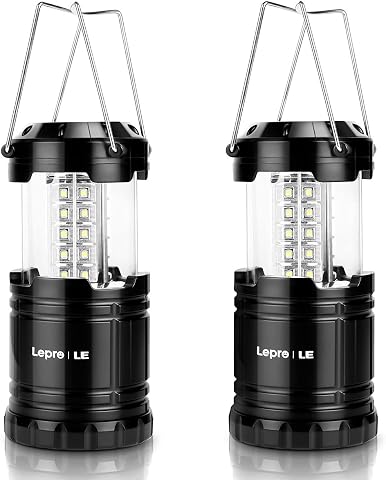
Lepro LED Camping Lanterns, 2 Pack
- ✔ Pack size: Two lanterns
- ✔ Output: 190 lumens per lantern
- ✔ Battery life: Up to 14 hours listed

Collapsible Portable LED Camping Lantern XTAUTO, 4-Pack
- ✔ Pack size: Four lanterns
- ✔ Battery: Built-in 1600mAh rechargeable battery
- ✔ Charging: USB and solar
At a Glance
| Criteria | Rechargeable compact camping lanterns | Battery powered compact camping lanterns | Winner |
|---|---|---|---|
| Power restoration | Recharge by USB from an outlet or compatible power source | Replace depleted batteries with spares | Depends |
| Trip runtime and backup | Runtime depends on capacity and access to charging; a power bank can extend use | Fresh batteries restore power quickly; carry extras for longer trips | B |
| Weight and packability | Often compact, though battery capacity adds weight | Size varies; spare batteries add carried weight | Depends |
| Ongoing cost | No disposable battery purchases; charging still takes time | Recurring cost for replacements, reduced with rechargeable cells | A |
| Convenience between trips | Simple to top up alongside phones and other gear | Can sit unused without a charging routine, though cells may need checking | A |
| Low-power reliability | Built-in battery ages and cannot usually be swapped in the field | Field replacement is straightforward if compatible spares are available | B |
MalloMe Camping Lights LED Lantern Flashlights
The MalloMe makes the strongest case when we want a lantern that takes little room in a pack yet offers a comparatively high stated output. At 3.7 inches tall when collapsed and 5.76 ounces, it is the only option here with both a listed packed height and weight that directly support its compact claim. Its stated maximum of 300 lumens exceeds Lepro’s 190 lumens, which may help when we want to illuminate a tent or a small shared area rather than create a softer pool of light.Its operation is deliberately uncomplicated: pull it open to turn it on and push it closed to switch it off. That makes it easy to use without hunting for a button in the dark, but the supplied description does not say that opening gives graduated brightness control. Lepro, by comparison, explicitly describes brightness adjustment through its collapsible design, so it may suit campers who value a controllable output more than MalloMe’s higher maximum figure.Power is the key caveat for this compact pick. It needs three AAA batteries, not included, so we need to pack spares and check the listing carefully: some supplied product information elsewhere inconsistently mentions AA batteries. The listed description specifies AAA. Its materials are described as water resistant, but no IP rating is provided, leaving less certainty for wet-weather use than with Lepro’s IPX4 rating. Choose MalloMe for a small, bright, simple lantern; skip it if rechargeable power or clearly rated splash protection is essential.
Pros:
- Collapses to a listed 3.7 inches tall
- Highest stated output in this lineup at 300 lumens
- Lightweight at a listed 5.76 ounces
- Simple pull-open and push-closed operation
Cons:
- Three AAA batteries are not included
- No runtime or IP water-resistance rating is specified
- The supplied information is inconsistent about battery type; the description specifies AAA
Best for: Campers who prioritize a small packed lantern, a higher stated lumen output, and simple pull-to-operate controls.
Not ideal for: Campers who want included batteries, USB charging, a stated runtime, or a specific water-resistance rating.
Bottom line: For the smallest documented footprint and highest stated light output, MalloMe is our most balanced pick, provided we are comfortable carrying AAA batteries and accepting limited weather-rating detail.
“For the smallest documented footprint and highest stated light output, MalloMe is our most balanced pick, provided we are comfortable carrying AAA batteries and accepting limited weather-rating detail.”
Lepro LED Camping Lanterns, 2 Pack
Lepro’s advantage is right in the package: two collapsible lanterns make it easier to light separate spots, such as a tent and a picnic table, or to keep one as a spare. Each is rated at 190 lumens, which is lower than MalloMe’s stated 300, but area lighting is often more useful when divided between two locations than concentrated in one brighter lamp. The listed 14-hour battery life gives us a runtime reference that the MalloMe details do not provide.For camping in uncertain weather, Lepro also offers the clearest protection claim in this group: IPX4 splash resistance. That rating is relevant for light rain or splashes, not a reason to submerge the lantern. Each unit uses three AA batteries, which are not included. Compared with MalloMe’s AAA requirement, AA batteries may be easier for some households to share with other gear, but a two-pack means six cells are needed to power both lanterns.Lepro folds down for storage and switches on by pulling it open. The listing says the opening position can adjust brightness, giving it more control than MalloMe’s stated on/off action. Its listed dimensions are 3.35 inches square by 7.2 inches high, but the supplied details do not clearly identify those as collapsed dimensions, so we should not treat them as a definitive packed-size comparison. Pick this set when coverage across two camp areas and a stated splash rating matter more than maximum output from one lantern. MalloMe is the more compelling single-light choice for compactness and brightness.
Pros:
- Includes two lanterns for lighting separate areas
- Each lantern provides a stated 190 lumens
- IPX4 protection against splashes from any direction
- Listed battery life of up to 14 hours
Cons:
- Six AA batteries are required for both lanterns and are not included
- Lower stated output per lantern than MalloMe
- Supplied dimensions do not clearly establish collapsed packed size
Best for: Campers, couples, or families who want two battery-powered lights for separate spaces and value a stated IPX4 rating.
Not ideal for: Solo backpackers counting every ounce, or anyone seeking USB recharging and a smaller single-lantern setup.
Bottom line: Lepro is the practical choice when we want two splash-resistant camp lights and a stated runtime, even though the set is less compelling for a weight-conscious solo kit.
“Lepro is the practical choice when we want two splash-resistant camp lights and a stated runtime, even though the set is less compelling for a weight-conscious solo kit.”
Collapsible Portable LED Camping Lantern XTAUTO, 4-Pack
XTAUTO takes a different approach from the battery-first MalloMe and Lepro: USB and solar charging feed a built-in 1600mAh battery, and each lantern can serve as either a lantern or a flashlight. That combination makes it attractive for car camping, emergency kits, or trips where we want to avoid stocking disposable cells. The four-pack also makes it possible to spread lights around camp or keep several ready for household outages.Its collapsible body is described as phone-sized when folded, though the listing provides no exact packed dimensions or weight. That makes the compactness claim harder to compare directly with MalloMe’s measured 3.7-inch collapsed height. The product description states more than 25 hours of lighting when fully charged, but does not provide a lumen figure, so we cannot tell from the supplied details how its brightness compares with MalloMe’s 300 lumens or Lepro’s 190.The charging flexibility involves planning: USB charging requires access to a power source, while solar charging depends on suitable sunlight and time. We should not assume solar will replenish the lantern quickly or reliably during a cloudy trip. The listing calls the lantern waterproof, but gives no IP rating to clarify what that means in practice. This is the most versatile choice for rechargeable backup use and dual-purpose lighting, but Lepro provides a clearer splash-resistance specification and MalloMe gives a more useful size-and-output comparison for a single backpacking lantern.
Pros:
- USB and solar charging options
- Built-in 1600mAh rechargeable battery
- Lantern and flashlight functions in one unit
- Listing states more than 25 hours of lighting when fully charged
Cons:
- No exact dimensions, weight, or lumen output in the supplied details
- Solar charging depends on sunlight and may not suit every trip
- No IP rating is provided to clarify the waterproof claim
Best for: Campers and households seeking a multi-unit rechargeable kit with lantern and flashlight functions and access to USB or sunlight for charging.
Not ideal for: Backpackers needing verified packed dimensions and weight, a stated lumen output, or a clearly specified IP protection rating.
Bottom line: XTAUTO brings the broadest power and lighting flexibility, but its missing size and brightness figures make it a harder choice to recommend as a precisely compact backpacking lantern.
“XTAUTO brings the broadest power and lighting flexibility, but its missing size and brightness figures make it a harder choice to recommend as a precisely compact backpacking lantern.”
As an Amazon Associate we earn from qualifying purchases.
Key Differences
The practical distinction appears when the lantern runs low. A rechargeable model needs time connected to a suitable power source, which is convenient at home or when a power bank is part of the kit. A battery model can be running again in moments if you packed compatible spares. For a weekend camp, either approach can work; for several nights away from charging, replaceable power gives a clearer backup plan.
Cost and carrying weight depend on habits and design. Rechargeable lanterns avoid routine disposable cell purchases and remove the need to pack spares, but their built-in batteries age and may eventually require replacing the lantern. Battery models can use rechargeable cells too, although those cells still need a charger. Compare the complete setup: lantern, cables or charger, power bank, spare cells, and expected use. Brightness and runtime claims also vary with settings, so compare them at the light level you expect to use.
Detailed Comparison
Power restoration (Battery powered compact camping lanterns wins — moderate)
A rechargeable lantern is easy to top up before departure or from a power bank, but charging takes time and requires a compatible source. B can return to full power as soon as you replace its cells. B wins by a moderate margin for remote trips; A is simpler when charging gear is already available.Trip runtime and backup (Battery powered compact camping lanterns wins — moderate)
A can run for extended trips if you bring a power bank and accept the extra charging plan. B has the more direct backup: spare batteries can be carried and swapped without waiting. B wins moderately for multi-night outings far from power, while A can be equally practical on short trips or camps with charging access.Weight and packability (minor difference)
A avoids the bulk of a charger and spare cells, but a large built-in battery can make the lantern heavier. B may be light with its cells installed, while spares add weight. Neither power type wins across models; compare packed weight for the lantern and the backup you actually plan to carry.Ongoing cost (Rechargeable compact camping lanterns wins — moderate)
A usually costs less to operate because routine charging does not require buying replacement cells. B can cost more if it uses disposable batteries frequently, although rechargeable cells can reduce that expense. A wins moderately for frequent use; the difference is small for occasional outings or when B uses cells you already own.Convenience between trips (Rechargeable compact camping lanterns wins — minor)
A is easy to recharge alongside a phone, leaving it ready for a spontaneous outing if you remember to top it up. B can also wait ready with fresh cells, but its charge state may be uncertain after long storage. A wins slightly for regular campers with a charging routine; B suits people who prefer to keep spare cells on hand.Low-power reliability (Battery powered compact camping lanterns wins — moderate)
A depends on a built-in battery whose capacity declines with age, and many compact designs do not let users replace it. B remains usable with fresh compatible cells, provided you have packed them. B has a moderate advantage for long-term storage and field repairs; check whether the chosen battery model accepts common cells.Rechargeable compact camping lanterns: Pros and Cons
Pros:
- Convenient to recharge with other USB gear
- Typically lower ongoing cost for frequent use
- No need to carry separate spare cells for ordinary short trips
Cons:
- Needs charging time and a power source
- Built-in battery capacity declines with age
- A dead lantern may stay dead in the field without a power bank
Battery powered compact camping lanterns: Pros and Cons
Pros:
- Fresh batteries restore power quickly
- Easy to plan backup for longer trips by packing spares
- Can suit infrequent use without a pre-trip charging routine
Cons:
- Disposable cells add recurring cost and waste
- Spare batteries increase pack weight and need proper storage
- Runtime and compatibility depend on the battery type
Who Should Choose What
Choose Rechargeable compact camping lanterns if:
- You camp regularly and can charge the lantern before leaving
- You already carry a power bank and want to reduce disposable battery use
- You value a simple setup for weekend trips and campsite use
Choose Battery powered compact camping lanterns if:
- You camp for several nights away from outlets and prefer carrying spare power
- You want to restore light immediately instead of waiting for a recharge
- You use the lantern irregularly and want to avoid relying on a built-in battery’s stored charge
Skip both if: Neither power type fits if you need high-output area lighting for a large group; compare larger lanterns with verified runtime at the brightness you need.
Value for Money
Rechargeable is usually the better value for frequent campers because regular use spreads the purchase cost across many outings and avoids repeated disposable cell purchases. Paying more for a rechargeable model can make sense if its capacity, charging port, and runtime match your routine. Battery powered is worth its cost when quick replacement matters more than low operating expense, particularly on trips without dependable charging. A model that accepts rechargeable cells can narrow the running-cost gap, though it adds the cost and planning of a separate charger. Compare the full kit price and the backup method, not just the lantern.
Final Verdict
For most weekend campers who can charge gear before leaving, choose a rechargeable compact lantern: it is convenient, economical with regular use, and avoids packing spare cells. Choose a battery powered lantern if your trips run beyond easy charging access or you want the certainty of swapping in fresh power. The deciding factor is your backup plan when the light runs low. Paying more for rechargeable makes sense for frequent use; pay for replaceable batteries when field recovery matters more than charging convenience.
Frequently Asked Questions
Are rechargeable camping lanterns better than battery powered ones?
For frequent campers with charging access, rechargeable models are often cheaper and easier to maintain. Battery powered models are better when you need quick power replacement far from outlets. Neither is universally better; the trip length and backup plan decide.
Which type is better for a week without electricity?
A battery powered lantern is easier to keep running if you carry enough compatible spares. A rechargeable lantern can also work with a sufficiently capable power bank, but that adds a charging plan and gear to carry.
Do rechargeable lantern batteries lose capacity?
Yes. Built-in rechargeable batteries gradually lose capacity with age and use. Check whether the manufacturer offers a replacement battery or service, since some compact lanterns are not designed for user battery replacement.
Can battery powered lanterns use rechargeable cells?
Many can, but check the lantern’s stated battery type and voltage requirements. Rechargeable cells can reduce ongoing cost, though they need a compatible charger and may have different capacity or performance from disposable cells.