
For most campers, I’d start with the Coleman Classic Rechargeable LED Lantern as the best overall pick, while the Consciot 1000-Lumen Battery-Powered Lantern suits buyers who want adjustable brightness and the Glocusent Rechargeable Lantern offers a rechargeable option with a built-in battery. The lineup ranges from compact multi-packs to high-output lanterns, so the right choice depends on whether you value simple backup power, fewer battery changes, or broad campsite lighting. Brightness alone does not tell the whole story: power source, pack size, and ease of carrying can matter just as much outdoors. I’ve ranked these options by how well their features suit common camping needs, with drawbacks included alongside the strengths. Continue reading for the full breakdown and a guide to choosing the right lantern for your trips.

Get travel and outdoor gear delivered free with Prime
- Fast, free delivery on millions of items
- Prime Video, Amazon Music and more included
- Member-only deals all year
Complete the kit


Key Takeaways
- Rechargeable models lead for repeat use: amazon.com/dp/B09HN1BXRG?tag=dailybedroom.com-20&ascsubtag=dc-1306681″ target=”_blank” rel=”nofollow sponsored noopener”>Coleman’s Classic Rechargeable and Consciot’s rechargeable 1000-lumen lantern avoid disposable batteries, while the battery-powered alternatives suit buyers who want replaceable power.
- High lumen figures do not make every lantern interchangeable: The Consciot battery-powered and Amazon Basics 1000-lumen models are geared toward broad campsite illumination, while compact lanterns favor easier packing and close-range use.
- Multi-packs solve a different problem than single lanterns: MalloMe, Lichamp, Eveready, and Etekcity bundles can spread light across tents or a group, but they bring more individual units to store and keep track of.
- Power flexibility is a standout distinction: XTAUTO combines solar and USB charging, while battery-operated lanterns offer a simpler backup plan when charging access is limited.
- Pick by lighting role, not just brightness: Models with dimming or several modes can adapt to different tasks, while compact or collapsible picks are a better match for portability and distributed lighting.
| MalloMe Collapsible LED Camping Lanterns, 2-Pack |  | Best Compact Pair | Pack size: 2 lanterns | Light source: COB LED | Maximum light output: 300 lumens | VIEW LATEST PRICE | See Our Full Breakdown |
| MalloMe Collapsible LED Camping Lanterns, 4-Pack |  | Best for Group Camp Setups | Pack size: 4 lanterns | Light source: LED | Maximum light output: 146 lumens per lantern | VIEW LATEST PRICE | See Our Full Breakdown |
| Lichamp 4-Pack LED Camping Lanterns, Battery-Powered, Collapsible, Gray |  | Best Water-Resistant Multi-Pack | Pack size: 4 lanterns | Light source: LED with COB technology | Maximum light output: 350 lumens per lantern | VIEW LATEST PRICE | See Our Full Breakdown |
| Coleman Classic Rechargeable LED Lantern |  | Best Rechargeable Option | Model: 2155747 | Light source: LED | Brightness settings: 100, 300, and 800 lumens | VIEW LATEST PRICE | See Our Full Breakdown |
| Consciot 1000-Lumen Battery-Powered LED Camping Lantern, Dimmable with 4 Light Modes | 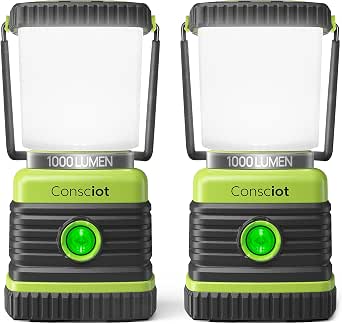 | Best for Maximum Battery-Powered Output | Maximum light output: 1000 lumens | Beam angle: 360 degrees | Light modes: Cool white, warm white, combined white, and strobe | VIEW LATEST PRICE | See Our Full Breakdown |
| Glocusent Rechargeable LED Camping Lantern with 5000mAh Battery |  | Best for Long, Adjustable Campsite Lighting | Maximum light output: 1500 lumens | Light source and coverage: 135 LEDs; 360-degree illumination | Brightness and color settings: 5 brightness levels; 3000K, 4500K, and 6001K | VIEW LATEST PRICE | See Our Full Breakdown |
| XTAUTO Collapsible Solar and USB Rechargeable LED Camping Lantern, 4-Pack |  | Best Multi-Lantern Set for Flexible Placement | Pack size: 4 lanterns | Charging: USB and solar | Battery capacity: 1600mAh | VIEW LATEST PRICE | See Our Full Breakdown |
| Eveready ALCL31 Collapsible LED Camping Lanterns, 3-Pack |  | Best for Battery-Powered Emergency Stations | Pack size: 3 lanterns | Maximum area output: 350 lumens | Directional output and range: 60 lumens; beam distance up to 100 m | VIEW LATEST PRICE | See Our Full Breakdown |
| Consciot Rechargeable 1000-Lumen LED Camping Lantern | 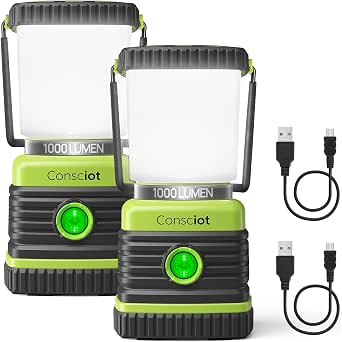 | Best for Fine-Tuned Brightness Control | Maximum light output: 1000 lumens | Beam coverage: 360 degrees | Light modes: Cool white, warm white, combined white, and strobe | VIEW LATEST PRICE | See Our Full Breakdown |
| Amazon Basics 1000-Lumen LED Camping Lantern, 360-Degree, Dimmable, IPX4 Water Resistant |  | Best for Simple Battery-Powered Camp Lighting | Maximum brightness: 1000 lumens | Light coverage: 360 degrees | Lighting modes: 4, including dimming and strobe | VIEW LATEST PRICE | See Our Full Breakdown |
| EZORKAS 4-Pack Rechargeable COB LED Camping Lanterns |  | Best Multi-Lantern Set | Quantity: 4 lanterns | Light source: COB LED | Lighting modes: 4, including flashlight, red strobe, and SOS | VIEW LATEST PRICE | See Our Full Breakdown |
| Coleman 1000-Lumen LED Lantern with BatteryGuard Technology |  | Best for Bright Campsite Lighting | Maximum light output: 1000 lumens | Beam distance: Up to 16 meters | Light modes: High, medium, low, and flashing | VIEW LATEST PRICE | See Our Full Breakdown |
| Consciot 2-Pack Rechargeable LED Camping Lanterns with Flashlights |  | Best for Versatile Emergency Use | Pack size: 2 | Maximum light output: 350 lumens | Lighting modes: 6 | VIEW LATEST PRICE | See Our Full Breakdown |
| Eveready GPAL411 Compact LED Lanterns, 2-Pack |  | Best for Long Battery Runtime | Pack quantity: 2 | Light output: Up to 250 lumens | Light coverage: 360 degrees | VIEW LATEST PRICE | See Our Full Breakdown |
| Etekcity LED Camping Lanterns, Battery Operated, 2 Pack |  | Best Compact Battery-Powered Pick | Pack contents: 2 lanterns and 6 AA batteries | Bulbs: 30 LEDs per lantern | Maximum brightness: 154 lumens per lantern | VIEW LATEST PRICE | See Our Full Breakdown |
| camping lantern | Water resistance | Maximum light output | Weight |
|---|---|---|---|
| MalloMe Collapsible LED Campin | Water resistant | 300 lumens | 5.76 ounces |
| MalloMe Collapsible LED Campin | Not water resistant | 146 lumens per lantern | — |
| Lichamp 4-Pack LED Camping Lan | Water resistant | 350 lumens per lantern | — |
| Coleman Classic Rechargeable L | IPX4 | — | 2.2 pounds |
| Consciot 1000-Lumen Battery-Po | IPX4 | 1000 lumens | 0.99 kg |
| Glocusent Rechargeable LED Cam | IP45 | 1500 lumens | — |
| XTAUTO Collapsible Solar and U | Described as waterproof; no IP rating specified | — | — |
| Eveready ALCL31 Collapsible LE | Not water resistant | — | 1.11 kg |
| Consciot Rechargeable 1000-Lum | IPX4 | 1000 lumens | — |
| Amazon Basics 1000-Lumen LED C | IPX4 | — | 0.39 kg |
| EZORKAS 4-Pack Rechargeable CO | Water resistant; rating not specified | — | — |
| Coleman 1000-Lumen LED Lantern | Water resistant | 1000 lumens | 1.3 pounds |
| Consciot 2-Pack Rechargeable L | IPX4 | 350 lumens | 12.16 oz |
| Eveready GPAL411 Compact LED L | IPX4 | — | — |
| Etekcity LED Camping Lanterns | — | — | 0.67 lb / 302 g |
More Details on Our Top Picks
MalloMe Collapsible LED Camping Lanterns, 2-Pack
This two-lantern set suits campers who want compact, simple area lighting without carrying a larger rechargeable unit. Each lantern opens to provide up to 300 lumens of 360-degree light, and the pull-up operation avoids fiddly controls when setting up a tent or reaching for emergency lighting. Foldaway handles make the pair easier to pack than bulkier options such as the Coleman Classic Rechargeable LED Lantern, though the Coleman offers much higher peak output and recharges instead of relying on replaceable batteries. The tradeoff here is power management: each MalloMe needs three AAA batteries, which are not included. Its water-resistant design is useful for damp outdoor conditions, but it is not a substitute for a lantern rated for immersion. I’d choose this pair for portability and straightforward use, not extended high-output lighting.
Pros:- Two compact lanterns provide up to 300 lumens each with 360-degree coverage
- Collapsible bodies and foldaway handles pack neatly
- Pull-up and push-down operation is easy to understand
- Water-resistant construction suits light outdoor exposure
Cons:- Each lantern needs three AAA batteries, and none are included
- Water resistance does not indicate protection against submersion
- Less suitable than higher-output models for lighting a large shared campsite
Best for: Tent campers and emergency-kit owners who want two lightweight, easy-to-store lanterns for modest-area lighting
Not ideal for: Campers who need long runtimes without spare batteries, very bright group-site lighting, or a rechargeable power source
- Pack size:2 lanterns
- Light source:COB LED
- Maximum light output:300 lumens
- Beam angle:360 degrees
- Power:3 AAA batteries per lantern; batteries not included
- Water resistance:Water resistant
- Dimensions:3.7 × 3.4 × 3.7 inches
- Weight:5.76 ounces
- Warranty:1 year
Our verdict“Choose this pair for compact, uncomplicated tent and backup lighting, but pick the Coleman Classic Rechargeable LED Lantern for greater output and rechargeable convenience.”
MalloMe Collapsible LED Camping Lanterns, 4-Pack
The appeal of this set is four separate light sources: campers can spread them across tents, a cooking area, and a path rather than depend on one central lantern. Each provides up to 146 lumens with adjustable brightness, so output is more modest than the Lichamp 4-Pack’s stated 350 lumens per lantern, but the MalloMe set gives buyers a useful way to distribute light. Its collapsible design and distinct color options also make the lanterns easy to assign and store. The catch is weather protection: unlike the water-resistant Lichamp units, these are described as not water resistant, so I’d keep them under shelter in wet conditions. They also require 12 AA batteries across the set, sold separately. This is a practical choice for dry campsites where quantity matters more than peak brightness.
Pros:- Four lanterns let groups distribute light across several areas
- Adjustable brightness helps tailor output to the task
- Collapsible construction stores compactly
- Different color options help distinguish lanterns among group members
Cons:- Requires 12 AA batteries in total, which are not included
- Not water resistant, limiting use in exposed wet conditions
- 146-lumen maximum per lantern is lower than the Lichamp 4-Pack’s listed output
Best for: Families or groups who want several adjustable lanterns to place around a dry campsite or inside separate tents
Not ideal for: Campers expecting rain exposure or wanting brighter individual lanterns with fewer batteries to manage
- Pack size:4 lanterns
- Light source:LED
- Maximum light output:146 lumens per lantern
- Beam angle:360 degrees
- Brightness:Adjustable
- Power:12 AA batteries total; batteries not included
- Water resistance:Not water resistant
- Material:ABS plastic
- LED lifespan:100,000 hours
Our verdict“Pick this set when a group needs four adjustable lights for sheltered sites, but choose the water-resistant Lichamp 4-Pack for brighter, more weather-tolerant coverage.”
Lichamp 4-Pack LED Camping Lanterns, Battery-Powered, Collapsible, Gray
For buyers who want multiple lanterns but do not want to treat every one as indoor-only gear, this set brings together four collapsible lights and water-resistant construction. Each is rated for up to 350 lumens across a 360-degree beam, giving it a brighter individual-lighting role than the MalloMe 4-Pack’s 146-lumen units. The foldaway handles allow carrying or hanging, and the stated 30-hour battery life helps with longer trips, though actual runtime depends on use. One control detail may divide buyers: opening the lantern turns it on, with no separate switch. That makes operation simple, but it can be awkward when adjusting or packing the light. Three AA batteries per lantern are not included, so stocking four units means planning for 12 batteries. I’d favor this set for distributed campsite lighting where water resistance and output matter more than refined controls.
Pros:- Four lanterns provide flexible coverage around camp
- Up to 350 lumens and 360-degree illumination per lantern
- Water-resistant plastic construction is better suited to outdoor exposure than the MalloMe 4-Pack
- Foldaway handles support carrying or hanging
Cons:- Each lantern needs three AA batteries, none included
- Opening the lantern turns it on, with no separate switch
- Four units require managing a total of 12 batteries
Best for: Campers who want four relatively bright, water-resistant lanterns for tents, cooking areas, and other spread-out campsite zones
Not ideal for: Buyers who want a dedicated on/off switch or prefer a rechargeable lantern with no loose batteries
- Pack size:4 lanterns
- Light source:LED with COB technology
- Maximum light output:350 lumens per lantern
- Coverage:97 sq. ft.
- Beam angle:360 degrees
- Power:3 AA batteries per lantern; batteries not included
- Battery life:Up to 30 hours
- Water resistance:Water resistant
- Dimensions:3.38 × 3.38 × 9.56 inches
Our verdict“Choose the Lichamp set for brighter, water-resistant multi-area lighting, and skip it if a separate switch or rechargeable power matters more.”
Coleman Classic Rechargeable LED Lantern
This Coleman is the most capable choice here for campers who want strong, adjustable light without carrying a stack of disposable batteries. Its three settings reach 800 lumens, and the built-in 4800 mAh battery can run for up to 45 hours on low or flashing mode. Compared with the Consciot battery-powered lantern, it gives up some peak output and light-mode variety, but gains USB recharging and a device-charging port. That makes it more useful as a central camp light when phones or other small devices need a boost. The main compromise is high-mode endurance: runtime is up to five hours at 800 lumens, so full brightness is best saved for shorter tasks. At 2.2 pounds, it is also heavier than the compact MalloMe pair. IPX4 water resistance and impact resistance up to one meter add practical protection, not permission to submerge it.
Pros:- Three brightness settings reach up to 800 lumens
- Built-in rechargeable battery avoids routine disposable-battery replacement
- USB port can charge personal devices
- IPX4 water resistance and impact resistance up to one meter suit campsite handling
Cons:- High setting runs for up to five hours
- Built-in battery must be recharged before extended trips
- At 2.2 pounds, it is heavier than compact battery-powered options such as the MalloMe 2-Pack
Best for: Car campers and base-camp users who want a reusable central lantern with high output and the ability to charge small devices
Not ideal for: Backpackers prioritizing low weight, or campers who need all-night operation at maximum brightness without recharging
- Model:2155747
- Light source:LED
- Brightness settings:100, 300, and 800 lumens
- Battery:Built-in 4800 mAh rechargeable lithium-ion
- Runtime:Up to 5 hours on high; up to 45 hours on low or flashing
- Water resistance:IPX4
- Impact resistance:Up to 1 meter
- Weight:2.2 pounds
- Charging:USB device-charging port; USB-to-USB-C cord included
Our verdict“Choose the Coleman for rechargeable, high-output base-camp lighting and device backup, but pick a lighter lantern if pack weight is a priority.”
Consciot 1000-Lumen Battery-Powered LED Camping Lantern, Dimmable with 4 Light Modes
When brightness is the priority, this Consciot stands apart from the compact MalloMe lanterns with up to 1000 lumens of 360-degree light. Its four modes—cool white, warm white, combined white, and strobe—plus stepless dimming let campers tune the light for cooking, relaxing, or signaling. A carrying handle and hanging hooks add flexibility, while the removable diffuser can soften the beam for close-up use. The tradeoff is a reliance on three D-cell batteries, which are not included; the product lists up to 12 hours at maximum brightness, so battery planning matters on longer trips. It also weighs 0.99 kg, making it less appealing for backpacking than the smaller MalloMe pair. IPX4 protection handles splashes, not immersion. I’d pick it for a car-camping group that wants strong, adjustable light rather than the convenience of a rechargeable Coleman.
Pros:- Up to 1000 lumens with 360-degree illumination
- Four lighting modes and stepless dimming suit different camp tasks
- Handle, hanging hooks, and removable diffuser offer flexible placement
- IPX4 water resistance provides protection against splashes
Cons:- Requires three D-cell batteries, which are not included
- Listed maximum-brightness runtime is up to 12 hours
- At 0.99 kg, it is less convenient to carry than the compact MalloMe 2-Pack
Best for: Car campers and emergency-preparedness buyers who want a bright, dimmable lantern with multiple white-light options
Not ideal for: Backpackers, buyers avoiding bulky D-cell batteries, or anyone needing a lantern that can be submerged
- Maximum light output:1000 lumens
- Beam angle:360 degrees
- Light modes:Cool white, warm white, combined white, and strobe
- Dimming:Stepless
- Power:3 D-cell alkaline batteries; batteries not included
- Runtime:Up to 12 hours at maximum brightness
- Water resistance:IPX4
- Dimensions:3.54 × 3.86 × 7.28 inches
- Weight:0.99 kg
Our verdict“Choose this Consciot for bright, adjustable battery-powered campsite lighting, but pick the Coleman Classic Rechargeable LED Lantern if rechargeable convenience matters more than peak output.”
Glocusent Rechargeable LED Camping Lantern with 5000mAh Battery
The Glocusent is a strong fit for campers who want control over both brightness and light tone rather than a simple on-or-off lantern. Its 360-degree spread, five brightness levels, and three color temperatures make it easier to set a softer glow inside a tent or brighter light around a shared campsite. The 5000mAh battery also gives it a longer low-setting runtime than the XTAUTO’s stated 25 hours, while USB-C recharging avoids disposable batteries. It can charge a phone in an emergency, though that use draws from the same battery you need for light. One caveat: the 1500-lumen maximum lasts only four minutes, so it is a brief boost rather than a sustained setting. The adapter is not included, and IP45 protection is not a substitute for keeping it out of heavy rain.
Pros:- Up to 200 hours of runtime on the low setting
- Five brightness levels and three color temperatures suit different camp tasks
- USB-C charging and emergency phone-charging capability
- Compact body with a handle and bottom hook for carrying or hanging
Cons:- 1500-lumen maximum brightness lasts only four minutes
- Power adapter is not included
- IP45 protection does not make it suitable for heavy rain or immersion
Best for: Campers who want rechargeable, adjustable 360-degree light for extended trips and occasional emergency phone charging
Not ideal for: Buyers who need sustained maximum brightness, a wall adapter in the box, or a lantern for exposed use in heavy rain
- Maximum light output:1500 lumens
- Light source and coverage:135 LEDs; 360-degree illumination
- Brightness and color settings:5 brightness levels; 3000K, 4500K, and 6001K
- Battery capacity:5000mAh
- Runtime:Up to 200 hours on low; up to 12 hours at maximum brightness
- Charging:USB-C; 3.5-hour charging time
- Water resistance:IP45
- Weight and dimensions:299 g; 3.43 × 3.43 × 7.28 in
Our verdict“Choose the Glocusent if long low-level runtime and adjustable light matter more than sustained maximum output.”
XTAUTO Collapsible Solar and USB Rechargeable LED Camping Lantern, 4-Pack
The XTAUTO set suits groups who would rather spread light across several spots than rely on one brighter lantern. Four collapsible units can be divided between tents, a cooking area, and a vehicle, and each doubles as a flashlight when directional light is more useful. USB and solar charging offer flexibility when outlets are scarce, but solar is a backup option whose usefulness depends on sun exposure and charging time. The stated up-to-25-hour battery life is modest beside the Glocusent’s low-setting claim of up to 200 hours, and the XTAUTO description does not specify lumen output, so it is harder to judge how well one unit will light a larger area. Its water resistance is described as waterproof without an IP rating, leaving less clarity than the IPX4-rated Consciot.
Pros:- Four collapsible lanterns can be placed around camp or divided among users
- Each unit works as both a 360-degree lantern and a flashlight
- USB and solar charging provide two charging routes
- Up to 25 hours of stated battery life
Cons:- Solar charging depends on available sunlight
- No lumen rating is provided to clarify brightness
- Waterproofing is claimed without a specific IP rating
Best for: Families or car campers who want several compact lights for separate tents, cooking areas, or emergency kits
Not ideal for: Backpackers focused on minimizing gear, campers who need verified water-resistance details, or anyone seeking a clearly specified high-output lantern
- Pack size:4 lanterns
- Charging:USB and solar
- Battery capacity:1600mAh
- Battery life:Up to 25 hours
- Lighting coverage:360 degrees
- Functions:Lantern and flashlight
- Color temperature:6000K
- Water resistance:Described as waterproof; no IP rating specified
Our verdict“Pick this four-pack for spreading basic light around camp, not for a single high-output lantern with fully documented weather protection.”
Eveready ALCL31 Collapsible LED Camping Lanterns, 3-Pack
The Eveready set is better suited to a prepared camp or emergency kit than to trips where wet weather is likely. Its three AA-powered lanterns do not depend on a rechargeable battery being topped up, and each offers area light, directional light, red flashing, and red SOS modes. The directional beam reaches up to 100 meters, giving it a practical role beyond lighting a table. Compared with the rechargeable Glocusent, these units trade charging convenience and adjustable color temperatures for a replaceable-battery setup and a pack of separate lights. The base magnets add useful placement options on metal surfaces, but the lanterns are explicitly not water resistant. Each also needs three AA batteries, so keeping all three ready means carrying or storing a sizable supply.
Pros:- Three lanterns provide separate lights for different camp locations
- Area, directional, red flashing, and red SOS modes cover varied needs
- Directional light has a stated beam distance of up to 100 meters
- Collapsible bodies, handles, hanging hooks, and base magnets add placement flexibility
Cons:- Not water resistant
- Each lantern requires three AA batteries
- Listed battery life is 16 hours
Best for: Campers building a dry-weather backup kit who want multiple battery-powered lights with directional and SOS modes
Not ideal for: Campers expecting rain, those who prefer rechargeable gear, or backpackers who need to limit battery and pack weight
- Pack size:3 lanterns
- Maximum area output:350 lumens
- Directional output and range:60 lumens; beam distance up to 100 m
- Light modes:Area, directional, red flashing, and red SOS
- Power source:3 AA batteries per lantern
- Battery life:16 hours
- Water resistance:Not water resistant
- Weight:1.11 kg
Our verdict“Choose the Eveready pack for dry, battery-ready camps where multiple modes and separate light sources matter more than weather protection.”
Consciot Rechargeable 1000-Lumen LED Camping Lantern
The Consciot stands out for campers who want to adjust brightness gradually instead of choosing from fixed steps. Its stepless dimming and four modes let one lantern shift from softer tent light to a brighter 360-degree work area, while the 1000-lumen ceiling is a more clearly specified output than the XTAUTO’s. USB-C recharging and a built-in phone-charging function add utility away from an outlet; that convenience can leave less battery for lighting if both jobs are needed. The IPX4 rating covers splashes, not immersion, so it is suitable for cautious outdoor use rather than submersion. There is also conflicting battery information: the description identifies a rechargeable 4400mAh battery, while the product data mentions two included C batteries. I would verify the power setup before choosing it over the Glocusent.
Pros:- Up to 1000 lumens of 360-degree illumination
- Stepless dimming gives finer control than fixed brightness steps
- Four modes include cool white, warm white, combined white, and strobe
- USB-C charging, phone-charging capability, handle, and hanging hooks
Cons:- Battery details conflict between the rechargeable 4400mAh description and mention of two C batteries
- IPX4 protection covers splashes, not immersion
- Runtime is not specified in the provided product data
Best for: Campers who value gradual brightness adjustment, rechargeable operation, and a lantern that can provide emergency phone power
Not ideal for: Buyers who need unambiguous power-source details, immersion protection, or a lantern with a clearly stated long runtime
- Maximum light output:1000 lumens
- Beam coverage:360 degrees
- Light modes:Cool white, warm white, combined white, and strobe
- Dimming:Stepless
- Battery information:4400mAh rechargeable battery stated; product data also mentions two included C batteries
- Charging port:USB-C
- Water resistance:IPX4
- Dimensions:3.54 × 3.86 × 7.28 in
Our verdict“Choose the Consciot for adjustable, rechargeable campsite light if you are comfortable confirming its battery configuration before purchase.”
Amazon Basics 1000-Lumen LED Camping Lantern, 360-Degree, Dimmable, IPX4 Water Resistant
The Amazon Basics lantern is a straightforward choice for campers who want 1000-lumen, 360-degree light without depending on a rechargeable battery. It runs on three D-cell batteries, which can be useful on trips where replacing batteries is easier than arranging USB charging. Its four modes include dimming and strobe, and the IPX4 rating offers splash protection for ordinary outdoor use. Compared with the rechargeable Consciot, it gives up USB-C charging and phone-power capability, but avoids that model’s conflicting battery information. The tradeoff is ongoing battery dependence: three D cells are not included, and the product data does not state runtime. It is also less adaptable than the Glocusent, which offers multiple color temperatures and a much longer stated low-setting runtime.
Pros:- 1000-lumen output with 360-degree illumination
- Four lighting modes include dimming and strobe
- IPX4 water resistance offers protection from splashes
- Replaceable D-cell power avoids reliance on USB charging
Cons:- Requires three D-cell batteries, which are not included
- Runtime is not specified in the product data
- No rechargeable battery or phone-charging function is listed
Best for: Car campers and household emergency planners who prefer replaceable D-cell power and need bright area lighting
Not ideal for: Backpackers avoiding battery weight, campers who want rechargeable or phone-charging capability, or buyers who need a stated runtime
- Maximum brightness:1000 lumens
- Light coverage:360 degrees
- Lighting modes:4, including dimming and strobe
- Power source:3 D-cell batteries, not included
- Water resistance:IPX4
- Material:ABS
- Dimensions:3.54 × 3.54 × 7.28 in
- Weight:0.39 kg
Our verdict“Pick this lantern for bright, simple lighting when replaceable batteries suit your trip better than USB recharging.”
EZORKAS 4-Pack Rechargeable COB LED Camping Lanterns
The four-lantern bundle suits group camps and emergency kits where spreading light across several spots matters more than maximizing one lantern’s output. Its collapsible COB design gives 360-degree coverage, while USB recharging and a three-AA backup option offer flexibility if charging is unavailable. Compared with the Consciot 2-Pack Rechargeable LED Camping Lanterns, EZORKAS supplies more individual lights and adds a magnetic base; Consciot instead specifies USB-C, power-bank output, and IPX4 protection. EZORKAS also includes flashlight and emergency signaling modes, but its water resistance has no stated rating, so I would not choose it for exposed, wet conditions. AA batteries are not included, and the listed dimensions describe a relatively substantial package. This is a practical pick for distributing light, not a clearly weather-rated or high-output centerpiece.
Pros:- Four lanterns make it easier to light separate tents, tables, or work areas.
- USB rechargeable with three-AA battery backup for charging flexibility.
- 360-degree light and flashlight, red-strobe, and SOS modes add useful options.
- Collapsible bodies, hanging handles, and magnetic bases support varied placement.
Cons:- AA batteries for backup use are not included.
- Water resistance is stated without a rating, leaving wet-weather limits unclear.
- No lumen output or battery runtime is provided for judging brightness and endurance.
Best for: Group campers and households building an emergency kit who want several rechargeable lanterns to place around a campsite or shelter.
Not ideal for: Campers who expect heavy rain or need a published water-resistance rating, or anyone wanting a clearly specified high-lumen primary lantern.
- Quantity:4 lanterns
- Light source:COB LED
- Lighting modes:4, including flashlight, red strobe, and SOS
- Power:USB rechargeable or 3 AA batteries per lantern; batteries not included
- Beam angle:360 degrees
- Material:ABS
- Water resistance:Water resistant; rating not specified
- Special features:Collapsible design, hanging handle, and 3 magnetic base magnets
Our verdict“Choose this set when four flexible lanterns matter more than a published brightness or weather-protection rating.”
Coleman 1000-Lumen LED Lantern with BatteryGuard Technology
For buyers who want one lantern to illuminate a shared campsite, the 1000-lumen maximum output gives this Coleman a clearer role than the smaller, lower-output lights in this group. Four modes let me trade brightness for a more restrained setting, and BatteryGuard technology is intended to help preserve battery life between uses. Its water- and impact-resistant build also makes it a more reassuring choice for rougher handling than the Eveready GPAL411 Compact LED Lanterns, whose stated drop resistance reaches one meter. The tradeoff is dependence on alkaline batteries: unlike the Consciot 2-Pack Rechargeable LED Camping Lanterns, it cannot be replenished over USB or serve as a phone power bank. The specified beam distance is modest, too, so its strong output is best for nearby camp spaces rather than lighting far down a trail.
Pros:- Up to 1000 lumens can light a shared camp area more strongly than the lower-output options here.
- High, medium, low, and flashing modes allow brightness and use to be adjusted.
- BatteryGuard technology is designed to preserve battery life between uses.
- Water- and impact-resistant construction suits camping and emergency storage.
Cons:- Runs on alkaline batteries rather than a rechargeable built-in battery.
- At 1.3 pounds, it is less suited to weight-conscious hiking than compact options.
- Beam distance is specified at up to 16 meters, limiting its appeal for lighting distant areas.
Best for: Car campers who need a bright central lantern for a picnic table, group campsite, or emergency room lighting and are willing to pack alkaline batteries.
Not ideal for: Backpackers prioritizing low carry weight or campers who prefer USB-rechargeable gear and phone-charging capability.
- Maximum light output:1000 lumens
- Beam distance:Up to 16 meters
- Light modes:High, medium, low, and flashing
- Power source:Alkaline batteries
- Water resistance:Water resistant
- Impact resistance:Up to 2 meters
- Weight:1.3 pounds
- Warranty:3-year limited warranty
Our verdict“Pick the Coleman for strong, adjustable light at a shared campsite if carrying alkaline batteries is acceptable.”
Consciot 2-Pack Rechargeable LED Camping Lanterns with Flashlights
The lantern-and-flashlight combination makes this two-pack more adaptable than a basic area light: each unit can illuminate a campsite broadly or direct a beam where someone is walking. Its USB-C charging and 3600 mAh battery remove the need to carry disposable cells, while power-bank functionality can provide a small backup for a phone. Compared with the EZORKAS 4-Pack Rechargeable COB LED Camping Lanterns, Consciot offers fewer units but specifies IPX4 splash protection and a 350-lumen maximum output. Six modes, including steady red and red SOS, add options for signaling or preserving night vision. The tradeoffs are that IPX4 does not cover submersion, and 350 lumens is not in the same class as the Coleman 1000-lumen lantern. I’d favor this set for flexible personal lighting, not as the brightest group-camp centerpiece.
Pros:- Two light types in each unit handle campsite lighting and directed flashlight use.
- USB-C charging and 3600 mAh batteries avoid dependence on disposable cells.
- Power-bank functionality offers a backup charge for mobile devices.
- Six modes include steady red light and red SOS strobe, with IPX4 splash protection.
Cons:- Maximum output of 350 lumens is lower than the Coleman 1000-lumen option.
- IPX4 covers splashes, not submersion.
- Power-bank use draws from the same battery needed for lighting.
Best for: Campers who want two rechargeable lights with both hands-free area lighting and a forward-facing flashlight, plus occasional phone backup.
Not ideal for: Buyers who need a high-output lantern for lighting a large shared area or protection against immersion in water.
- Pack size:2
- Maximum light output:350 lumens
- Lighting modes:6
- Battery capacity:3600 mAh per lantern
- Charging:USB-C
- Power bank:Yes
- Water resistance:IPX4
- Weight:12.16 oz
Our verdict“Choose this two-pack for rechargeable, multi-purpose lighting and occasional device backup rather than maximum campsite brightness.”
Eveready GPAL411 Compact LED Lanterns, 2-Pack
The Eveready pair is a straightforward choice for campers who value long potential runtime over rechargeable convenience. Its stated maximum of up to 100 hours can suit extended trips or emergency storage, though actual endurance depends on batteries and settings. The flexible two- or four-AA configuration gives buyers a way to use fewer cells when appropriate, unlike the Etekcity LED Camping Lanterns, which require three AA batteries per lantern. Eveready also provides 360-degree light, IPX4 splash protection, and resistance to drops up to one meter. On the other hand, its 250-lumen ceiling is less suited to lighting a large shared area than the Coleman 1000-Lumen LED Lantern. Batteries are not included, and the stated 0.66 kg weight makes this less appealing for a compact backpacking kit than its name might suggest.
Pros:- Two lanterns provide separate lights for a tent and campsite table.
- Up to 100 hours of battery life is useful for longer trips or emergency storage.
- Can operate with either 2 or 4 AA batteries.
- 360-degree coverage, IPX4 protection, and one-meter drop resistance suit routine camp use.
Cons:- Requires AA batteries, and runtime varies with battery type and usage.
- Maximum output of 250 lumens falls well short of the Coleman 1000-lumen lantern.
- Listed weight of 0.66 kg per product makes it less compelling for weight-sensitive packing.
Best for: Car campers and emergency-kit planners who want a pair of battery lanterns with a long stated maximum runtime and flexible AA configurations.
Not ideal for: Backpackers seeking lightweight rechargeable lighting or campers who need a brighter lantern for a large group area.
- Pack quantity:2
- Light output:Up to 250 lumens
- Light coverage:360 degrees
- Battery type:AA
- Battery configuration:2 or 4 AA batteries
- Maximum battery life:Up to 100 hours
- Water resistance:IPX4
- Impact resistance:Drops up to 1 meter
Our verdict“Pick the Eveready pair for extended battery operation and flexible AA use, not for a lightweight or especially bright setup.”
Etekcity LED Camping Lanterns, Battery Operated, 2 Pack
The Etekcity two-pack focuses on simple, compact 360-degree lighting rather than extra modes or charging features. Each lantern collapses for storage, weighs 0.67 pounds, and runs for up to 50 hours on three AA batteries, making it an uncomplicated option for car campers who want a spare light ready to go. Unlike the Consciot 2-Pack Rechargeable LED Camping Lanterns, it does not need a charging cable and includes six AA batteries in the package; Consciot counters with USB-C recharging, a flashlight, and power-bank output. Etekcity’s 154-lumen maximum is enough for nearby tent or table use but notably below the Coleman 1000-lumen lantern. Its water resistance is not assigned a rating, so I would keep it out of sustained rain. The small storage compartment is handy for minor items, but does not replace a dedicated gear pouch.
Pros:- Two collapsible lanterns pack down for convenient storage.
- 360-degree illumination covers nearby tent and table areas.
- Up to 50 hours of runtime per lantern is useful for backup lighting.
- Six AA batteries are included, and each lantern has a small storage compartment.
Cons:- Maximum output of 154 lumens is modest compared with the Coleman 1000-lumen lantern.
- Requires three AA batteries per lantern and has no rechargeable option.
- Water resistance is stated without a rating, so wet-weather limits are unclear.
Best for: Car campers and occasional campers who want two compact backup lanterns, included AA batteries, and uncomplicated area lighting.
Not ideal for: Campers who need high-output group lighting, rechargeable operation, or a specified water-resistance rating for wet conditions.
- Pack contents:2 lanterns and 6 AA batteries
- Bulbs:30 LEDs per lantern
- Maximum brightness:154 lumens per lantern
- Beam angle:360 degrees
- Battery:3 AA batteries per lantern
- Battery life:Up to 50 hours
- Material:ABS
- Weight:0.67 lb / 302 g
Our verdict“Choose Etekcity for compact, ready-to-use backup lighting, but look elsewhere for rechargeable power or strong area illumination.”

How We Picked
I compared these camping lanterns by the problems they solve at camp: lighting a shared area, lighting a tent, packing small, or providing an alternative to disposable batteries. Brightness claims and available modes matter, but I also weighed how the power source affects planning, how easily a lantern can fit into a kit, and whether a bundle gives a group useful coverage or just extra units. Water resistance, where specified, also matters for gear used outdoors, though it does not make a lantern suitable for submersion.
The ranking favors useful versatility over a single headline specification. Rechargeable and dimmable models earn attention for repeat trips and adjustable light; battery-powered designs remain strong choices for replaceable power and emergency storage. Multi-packs rank higher for buyers who need several light points, while compact models suit lighter kits. I also account for tradeoffs: charging requires planning, batteries require replacements, and a high-output lantern can be more than a tent or bedside task needs.
| camping lantern | Water resistance |
|---|---|
| MalloMe Collapsible LED Campin | Water resistant |
| MalloMe Collapsible LED Campin | Not water resistant |
| Lichamp 4-Pack LED Camping Lan | Water resistant |
| Coleman Classic Rechargeable L | IPX4 |
| Consciot 1000-Lumen Battery-Po | IPX4 |
| Glocusent Rechargeable LED Cam | IP45 |
| XTAUTO Collapsible Solar and U | Described as waterproof; no IP rating specified |
| Eveready ALCL31 Collapsible LE | Not water resistant |
| Consciot Rechargeable 1000-Lum | IPX4 |
| Amazon Basics 1000-Lumen LED C | IPX4 |
| EZORKAS 4-Pack Rechargeable CO | Water resistant; rating not specified |
| Coleman 1000-Lumen LED Lantern | Water resistant |
| Consciot 2-Pack Rechargeable L | IPX4 |
| Eveready GPAL411 Compact LED L | IPX4 |
| Etekcity LED Camping Lanterns | — |
Factors to Consider When Choosing Camping Lanterns
Before choosing among these camping lanterns, decide how and where you’ll use the light. A lantern for a picnic table has different demands from one that stays in a tent or waits in an emergency kit. These broader factors can help you avoid paying for features that do not fit your routine.
Match Brightness to the Space
Think about the area you need to light before chasing the highest lumen figure. A large shared campsite may benefit from broad, strong output, while a small tent can feel uncomfortably bright with the lantern set to full power. Dimming gives more control, but check whether the product lists adjustable output rather than assuming that multiple modes all offer a softer setting. A common mistake is choosing one very bright lantern to serve every purpose; a compact secondary light can be more useful for close tasks. If you camp with a group, placing several modest lights around the site can reduce dark spots better than relying on a single central source.
Choose a Power Plan That Fits Your Trips
Rechargeable lanterns make sense when you can charge them before a trip and want to avoid carrying spare disposable batteries. Battery-operated models are easier to revive away from outlets if you pack fresh cells, which can be reassuring for long trips or an emergency kit. Solar charging adds another route, but it depends on access to useful sunlight and should not be treated as a guaranteed overnight refill. Check whether the listing gives clear information about charging and expected runtime at different settings; maximum brightness can drain power faster than a low setting. The best power source is the one you can reliably maintain, not the one with the longest feature list.
Decide Whether You Need One Light or Several
A multi-pack can be a practical way to put light in separate tents, around a cooking area, and near gear without moving one lantern all evening. It can also create storage clutter if your usual trips need only one central light. Compare the intended job of each included lantern, rather than treating a larger pack as automatically better value. For families or group camping, several simple units can offer more flexible placement and a backup if one is misplaced. Solo campers and minimal packers may prefer a single lantern with more lighting control.
Balance Portability Against Stability and Use
Collapsible lanterns can take up less room when packed, which helps when storage space is limited. Compact designs may be less convenient if they are awkward to set down, hang, or operate with cold hands, so check the product’s shape and handling details before choosing. Consider where the lantern will sit: a table, tent hook, or ground-level spot may call for different forms. A larger lantern can be a better base-camp choice even if it is not the easiest option to carry far. Avoid selecting solely by folded size if you will use the light frequently at a fixed campsite.
Read Weather Claims Carefully
Outdoor use exposes a lantern to splashes, damp surfaces, and sudden rain, so a stated water-resistance rating can help narrow your options. An IPX4 rating indicates protection against splashing water, not immersion or prolonged exposure to heavy rain. Do not infer weather protection from a rugged appearance or a camping label when the listing does not give a rating. Store rechargeable electronics in a dry place between trips and protect any lantern during severe weather. If your trips often involve wet conditions, prioritize clearly stated protection and treat the lantern as one part of a broader dry-storage plan.
Check What Each Lighting Mode Is For
Extra modes can help a lantern handle different tasks, but they only add value when you know when you would use them. Dimming is useful for reducing glare or conserving power; a flashlight function can help when walking away from camp. A flashing or colored mode may be less useful for routine campsite lighting, so do not let the mode count substitute for practical controls. Look for simple access to the setting you use most, especially if the lantern may be used during a power outage. If the controls are unclear from the product information, a simpler lantern may be easier to rely on.
Frequently Asked Questions
Should I choose a rechargeable lantern or one that uses replaceable batteries?
Choose rechargeable if you can charge the lantern before trips and expect to use it often; this can reduce the need to pack disposable cells. Replaceable-battery models can be easier to keep ready for long trips or emergency storage, provided you keep spare batteries on hand. Solar and USB options add charging flexibility, but solar performance depends on sunlight and charging time. Compare the power source with the places you camp rather than assuming one type is always better. For a kit that may sit unused, check how the manufacturer recommends storing and maintaining the lantern.
Is a 1000-lumen lantern too bright for a tent?
It can be more light than a small tent needs at full output, but brightness control can make a high-output lantern useful in more than one setting. Look for dimming or clearly described lower modes if you want one lantern for both a shared campsite and close quarters. Without adjustment, a bright lantern may cause glare or feel harsh near sleeping areas. You can also place a lantern farther away or use it to light a common area rather than setting it beside your bed. Check product details for adjustable output instead of relying on the maximum lumen number alone.
Are multi-pack camping lanterns a good choice for a family?
They can be, especially when family members sleep in separate tents or you want light in several places at once. A pack lets you leave one lantern near the cooking area and another in a tent without moving a single shared light around. The tradeoff is that more units take up storage space and may require more batteries or charging attention. Consider whether each lantern can be used independently and whether the group needs several light points every trip. For a family that usually camps beside one table, one versatile lantern may be the simpler choice.
Can a solar-rechargeable lantern replace a USB-charged or battery-powered backup?
Solar charging can provide useful flexibility, but it depends on adequate sunlight and enough time to recharge. It is safer to treat solar as an added charging route than as the only power plan for a trip. USB charging is more predictable when you can bring a charged power bank, while replaceable batteries can help when outlets are unavailable. For emergency use, think through how you would restore power during cloudy weather or an extended outage. A lantern with more than one charging method may offer flexibility, though it can also require more planning.
What does IPX4 water resistance mean for camping use?
IPX4 indicates protection against splashing water from different directions; it does not mean a lantern can be submerged or left in heavy rain without care. That level can help with incidental splashes around a campsite, but exposure limits still matter. Keep the lantern out of standing water and protect charging ports according to the manufacturer’s instructions. If you camp in wet conditions, look for a clearly stated rating rather than assuming all outdoor lanterns have similar protection. A dry storage bag remains useful even when a product lists water resistance.
Conclusion
For a single lantern with broad appeal, I’d choose the Coleman Classic Rechargeable LED Lantern as the best overall option; buyers who want higher-output lighting with adjustable modes should compare it with the Consciot 1000-Lumen Battery-Powered Lantern. For best value, I’d look to a multi-pack such as the MalloMe Collapsible LED Lanterns, 2-Pack when several light points matter more than one feature-rich unit. The Coleman 1000-Lumen BatteryGuard Lantern is my premium-style pick for buyers prioritizing a high-output battery-powered design, while beginners who want straightforward campsite lighting may prefer the simple battery-operated Etekcity 2-Pack. For specific needs, the XTAUTO Solar and USB Rechargeable 4-Pack suits shoppers seeking multiple charging routes, and the Glocusent Rechargeable Lantern suits those who want a rechargeable option with a built-in battery. Choose based on where the light will go and how you will power it; that will narrow this lineup faster than brightness alone.