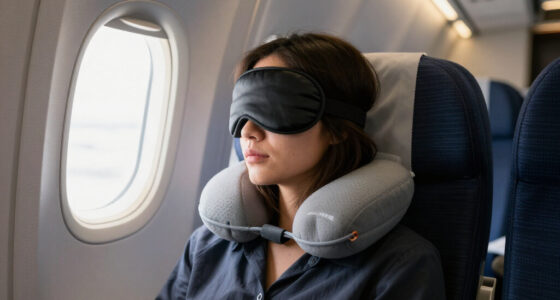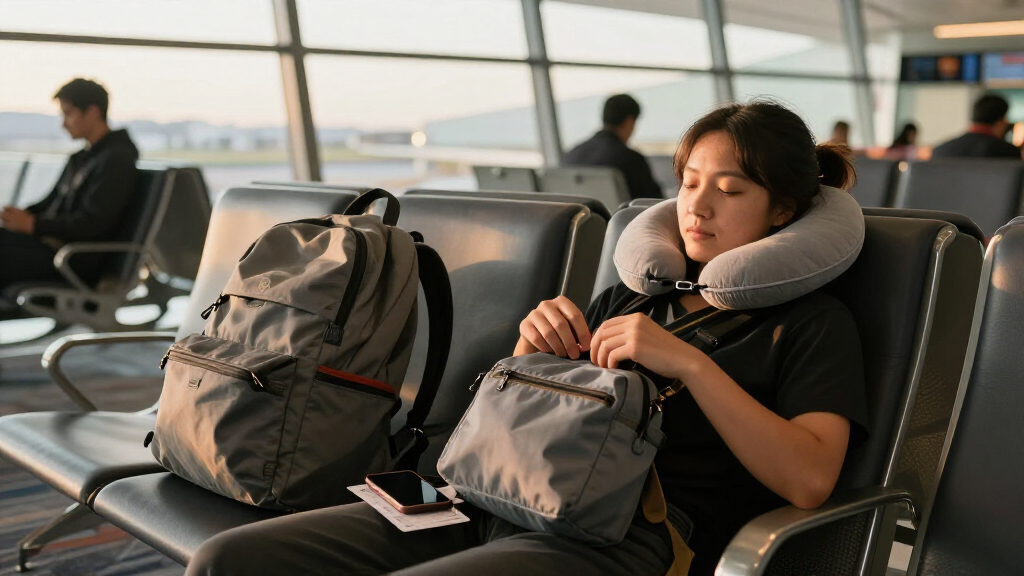

Compact travel pillow sets — typically a neck pillow bundled with an eye mask and earplugs, sometimes with a drawstring bag — come in two fundamentally different builds: memory foam and inflatable. Shoppers compare them because both promise the same outcome (actual sleep on a plane, train, or car ride) from a package that fits in carry-on luggage. The comparison is rarely about features or accessories; the masks and earplugs in most sets are roughly interchangeable. It is about the core tradeoff between comfort and packed size. Memory foam sets are heavier and bulkier even when compressed, but they cradle your head properly and hold their shape for years. Inflatable sets pack down to the size of a wallet but rely on air chambers and valves that feel less supportive and can fail. This guide compares both side by side across the criteria that actually decide the purchase — comfort, packed size, weight, durability, hygiene, ease of use in transit, and price — and tells you plainly which type fits which traveler. If you fly long-haul once a year and check a bag, the answer is different from someone doing weekly budget-airline hops with a personal item only.

Get travel and outdoor gear delivered free — and shop member deals
- Fast, free delivery on millions of items
- Access to Prime Big Deal Days deals on October 6–7
- Prime Video, Amazon Music and more included
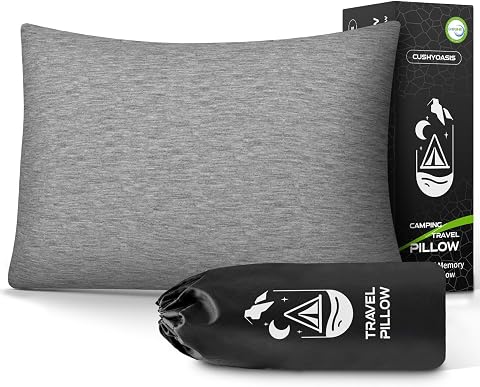
CushyOasis Camping Pillow Set with Travel Pillow, Eye Mask, and Earplugs
- ✔ Brand: CushyOasis
- ✔ Fill Material: Shredded memory foam, adjustable
- ✔ Dimensions: 16” x 12”

3-in-1 Travel Blanket and Pillow Set – 350 GSM Compact Airplane Blanket with Carry Bag and Inflatable Pillow (Mint Green)
- ✔ Material: 100% polyester flannel
- ✔ Blanket Thickness: 350 GSM
- ✔ Blanket Dimensions: 63" x 40"
At a Glance
| Criteria | Memory foam compact travel pillow set | Inflatable compact travel pillow set | Winner |
|---|---|---|---|
| Sleep comfort and neck support | Excellent: contoured foam holds head steady, no reinflation needed | Mediocre to fair: firmness adjustable by air, but bouncy and less stable | A |
| Packed size and portability | Bulky even compressed; typically fills a third of a daypack | Packs to roughly the size of a folded phone | B |
| Weight | 250–400g for the set | 80–150g for the set | B |
| Durability and lifespan | 3–5+ years; foam may soften slowly but rarely fails outright | 1–2 seasons typical; valves and seams are common failure points | A |
| Ease of use mid-journey | Ready instantly; no setup, just put it on | Requires 5–10 breaths and sometimes fiddly valves mid-flight | A |
| Hygiene and cleanability | Most covers are removable and machine washable; foam itself spot-clean only | Wipe-clean surfaces; fabric-lined versions harder to clean | A |
| Price and value | $25–60; higher upfront cost, long replacement cycle | $10–30; cheaper, but replacement costs add up | Depends |
CushyOasis Camping Pillow Set with Travel Pillow, Eye Mask, and Earplugs
This is the set we would hand to anyone whose primary goal is actually sleeping on a plane, train, or tent floor. Unlike the two inflatable-pillow sets in this lineup, the CushyOasis uses shredded memory foam with an adjustable fill, meaning you can add or remove foam (an extra bag is included) to dial in the exact height and firmness your neck needs. That single feature puts it in a different comfort class: inflatables rely on air pressure that shifts as you lean, while shredded foam holds its shape and redistributes under your head.The kit is also the most complete of the three. Alongside the pillow you get an eye mask, earplugs, storage bag, and machine-washable cover — the only set here that addresses light and noise, not just head position. The 16” x 12” footprint compresses into its storage bag reasonably well, though it will never pack as flat as either inflatable option. Compared with the Mint Green set, you trade the blanket entirely for a much better pillow; if you run cold on flights, that swap may not work for you.The honest drawbacks: the foam needs to be shaken and fluffed before it fully expands out of the bag, so it is not an instant-use item straight from your carry-on, and the 16” x 12” size will feel small to anyone used to a full bed pillow. For pure packability, both blanket sets beat it.
Pros:
- Adjustable shredded memory foam lets you customize height and firmness
- Most complete kit: eye mask, earplugs, extra foam, and storage bag included
- Machine-washable removable cover for easy cleaning
- Foam support stays consistent, unlike air-filled alternatives
Cons:
- Needs shaking and fluffing to fully expand before use
- 16” x 12” size may feel small for larger-framed sleepers
- No blanket included, unlike the other two sets
Best for: Travelers who prioritize genuine neck support and sleep quality on long flights, train journeys, or camping trips
Not ideal for: Minimalist packers who need everything to fold flat, or travelers who want a blanket included
Bottom line: The best choice for sleep quality, offering adjustable foam comfort and a full sleep kit that no inflatable set in this comparison can match.
“The best choice for sleep quality, offering adjustable foam comfort and a full sleep kit that no inflatable set in this comparison can match.”
3-in-1 Travel Blanket and Pillow Set – 350 GSM Compact Airplane Blanket with Carry Bag and Inflatable Pillow (Mint Green)
Think of this as the Light Grey set’s warmer sibling — and in our view, the stronger blanket-and-pillow package overall. The 350 GSM flannel fleece is the densest blanket in this comparison, noticeably heavier and more insulating than the Light Grey set’s 280gsm material. If you are the person who asks for two airline blankets, this is the set built for you: same 63" x 40" coverage, meaningfully more warmth.The carry bag is where this set earns extra credit. It includes a zippered pocket for a phone or passport — the only set here with secure essentials storage — and a dual-zipper design that doubles as a hand warmer, a small touch that frequent cold-climate travelers will appreciate more than they expect. The inflatable pillow features a leak-resistant valve, which addresses the most common failure point of cheap inflatables, though it still requires mouth inflation like the Light Grey set’s pillow.The tradeoffs are real: polyester fleece can shed and pill with repeated use, and the thicker fabric means this set packs slightly bulkier than the Light Grey option — the price of that warmth. Like all inflatable pillows, it falls well short of the CushyOasis on neck support. This pick makes the most sense for travelers who run cold and value bundled convenience, and less sense for anyone prioritizing genuine sleep ergonomics.
Pros:
- 350 GSM flannel is warmer and more durable than typical travel fleece
- Zippered carry-bag pocket secures phone, passport, and essentials
- Dual-zipper hand warmer design adds cold-weather convenience
- Leak-resistant valve on the inflatable pillow adds reliability
Cons:
- Pillow must be inflated by mouth
- Polyester fleece may shed or pill over time
- Thicker blanket packs slightly bulkier than the 280gsm alternative
Best for: Cold-sensitive travelers and campers who want maximum blanket warmth with smart storage
Not ideal for: Sleep-quality-focused travelers or those who want the smallest possible packed footprint
Bottom line: The warmest and most feature-rich blanket set here, best for travelers who value coziness and smart storage over pillow performance.
“The warmest and most feature-rich blanket set here, best for travelers who value coziness and smart storage over pillow performance.”
As an Amazon Associate we earn from qualifying purchases.
Key Differences
The single biggest practical gap is comfort. A contoured memory foam pillow does real work: it fills the space between your head and the window or headrest, distributes weight across your neck, and stays put when you fall asleep. Inflatable pillows support your head with trapped air, which means every movement of the vehicle — and every micro-adjustment you make — produces a slight bounce. Some travelers adjust firmness by inflating more or less, which is a genuine advantage foam lacks, but even at the ideal pressure, the experience is closer to resting on a firm balloon than on a cushion. For a two-hour nap the difference is tolerable. For an overnight long-haul flight, it is often the difference between arriving rested and arriving wrecked.
The counterweight is packability. This is where inflatable sets win decisively, and not by a small margin. A deflated inflatable set with its mask and earplugs fits into a jacket pocket or the side pocket of a sling bag, and weighs well under 150 grams. Even the most aggressively compressed memory foam set occupies a meaningful chunk of a daypack — the foam always rebounds toward its natural volume, and compression sacks only partly contain it. For travelers whose entire luggage is one personal item, or who only want the pillow available for the flight itself and resent carrying it for the rest of a two-week trip, that bulk is a real cost paid every single day of the journey.
Finally, there is durability. Memory foam sets degrade slowly and gracefully; after three years the foam may be slightly softer but still fully functional. Inflatable sets tend to fail suddenly — a valve that stops sealing, a seam that separates — usually at the worst possible moment, mid-flight. The practical consequence: inflatable owners should carry a mental backup plan, and budget for replacement roughly twice as often. That narrows the price gap over time, though inflatables still cost less in absolute terms.
Detailed Comparison
Sleep comfort and neck support (Memory foam compact travel pillow set wins — major)
This is the criterion that justifies the purchase, and memory foam wins clearly. Contoured foam pillows support the cervical curve, absorb the small jolts of turbulence, and — in the popular wraparound styles — hold your head in place even when you are not leaning against anything. Inflatable pillows offer adjustable firmness (a real, if modest, advantage) and some newer models use internal baffles that improve stability, but the fundamental physics of resting your head on air produce a bouncier, less reassuring experience. Side sleepers and people who nap against the window feel this gap most. If the set exists primarily so you can sleep on overnight flights, this difference alone should drive the decision toward foam.
Packed size and portability (Inflatable compact travel pillow set wins — major)
Inflatables win by a wide margin, and this is their entire reason to exist. A deflated set occupies roughly the volume of a smartphone; a memory foam set, even in a compression sack or clip-attached to a backpack, claims a third or more of a small daypack. The practical test: can you forget you are carrying the inflatable when you are not using it? Yes. Can you forget the foam one? No — you will notice it in museums, on hikes, and during every city walk of a multi-stop trip. Travelers using one-bag or personal-item-only strategies should weigh this heavily, because the foam set competes directly with a spare pair of shoes or a jacket for space.
Weight (Inflatable compact travel pillow set wins — minor)
Inflatable sets typically weigh 80–150 grams all-in; memory foam sets run 250–400 grams. The absolute numbers are small, and for most vacation travelers a 250-gram difference is irrelevant. It matters in only two realistic scenarios: ultralight backpacking where every gram is budgeted, and airline situations where you are already near a carry-on weight limit. Otherwise this criterion is a minor footnote — decide on size and comfort first, and let weight follow.
Durability and lifespan (Memory foam compact travel pillow set wins — moderate)
Memory foam sets last years. The foam compresses and recovers thousands of times, the fabric cover wears slowly, and failure usually means cosmetic fading rather than loss of function. Inflatable sets fail at their weak points: valves that leak after repeated use, seams that split, and punctures from keys or zipper teeth in a shared bag. A careful owner can extend an inflatable’s life by storing it loosely folded rather than tightly rolled, but the realistic lifespan is one to two travel seasons versus three to five for foam. If you travel more than a few times a year, foam’s durability largely cancels its higher price.
Ease of use mid-journey (Memory foam compact travel pillow set wins — moderate)
Foam is grab-and-go: put it on, close your eyes. Inflatable requires inflation — five to ten breaths, often through a valve you have to hold open or twist correctly — which is mildly annoying on a full flight while seatmates watch, and genuinely awkward if you deflate and reinflate between legs of a multi-stop itinerary. Inflating also dries your throat in cabin air. Some higher-priced inflatables include one-way push-button valves that make this nearly painless; cheap ones do not. Foam wins on friction, though not by a decisive margin for anyone who does not mind a few breaths.
Hygiene and cleanability (Memory foam compact travel pillow set wins — minor)
Most memory foam sets include a removable, machine-washable cover, which is what actually matters after your face has spent ten hours against the pillow. The foam core itself is spot-clean only and absorbs sweat over time if used uncovered. Inflatables wipe clean with a damp cloth because the surface is mostly thermoplastic, which resists odor better than exposed fabric — but fabric-lined inflatable models are the worst of both worlds: the lining traps oils and usually cannot be machine washed without risking the bladder. Read the listing carefully on this criterion; it varies by model more than by category. On average, foam with a washable cover is the safer hygiene bet.
Price and value (moderate difference)
Inflatable sets typically cost $10–30; memory foam sets $25–60, with premium contoured models above that. Inflatables are the cheaper entry point and the better value for occasional travelers — someone flying twice a year does not need to spend $50 on sleep infrastructure. For frequent travelers, the math shifts: foam lasts roughly three times as long, so its cost per trip drops below the inflatable’s once you fly more than a handful of times per year, and it delivers better sleep on every one of those trips. Pay more for foam only if you will use it often enough to amortize it; otherwise the inflatable’s lower price is the rational choice.
Memory foam compact travel pillow set: Pros and Cons
Pros:
- Genuinely comfortable — contoured support holds your head steady for real sleep
- Long lifespan: typically 3–5 years even with frequent use
- Ready instantly with no inflation or valve fiddling
- Machine-washable covers on most models keep it hygienic over time
- Often includes a clip or strap to attach outside a bag, partially offsetting the bulk
Cons:
- Bulky — occupies a third or more of a daypack even when compressed
- Heavier: 250–400g versus under 150g for inflatables
- Higher upfront cost, especially for well-contoured models
- You carry the size penalty for the entire trip, not just the flight
Inflatable compact travel pillow set: Pros and Cons
Pros:
- Packs down to pocket size — effectively disappears when not in use
- Featherweight at 80–150g for the full set
- Cheap entry point, usually $10–30
- Adjustable firmness by adding or releasing air
- Wipe-clean surfaces resist odor on most models
Cons:
- Noticeably less comfortable — bouncy, less stable head support
- Prone to valve and seam failures, often mid-trip
- Requires inflation mid-flight, which is awkward in a crowded cabin
- Fabric-lined versions are difficult to clean properly
- Expect to replace it every year or two with regular use
Who Should Choose What
Choose Memory foam compact travel pillow set if:
- You take long-haul or overnight flights even a few times a year and actually want to sleep
- You check a bag or carry a full-size carry-on, so bulk is not a daily burden
- You are a side sleeper or restless sleeper who needs stable, forgiving support
- You travel frequently enough that a longer-lasting pillow is worth the higher price
- You have neck or shoulder issues that air-chamber support aggravates
Choose Inflatable compact travel pillow set if:
- You travel with a personal item only and every cubic centimeter is contested
- Your trips are short-haul — the pillow is for a two-hour nap, not overnight sleep
- You travel infrequently and do not want to spend $50 on an occasional accessory
- You backpack or hike between destinations and count grams
- You want a spare set to keep permanently in a carry-on or glovebox
Skip both if: If you cannot sleep sitting up under any circumstances, no pillow set fixes that — a good pair of noise-reducing earplugs and a sleep mask on their own cost a fraction of either set. Likewise, if you only fly once every few years, buy a cheap inflatable alone and skip the bundled set entirely.
Value for Money
At face value the inflatable set looks like the value pick: half the price, a tenth of the packed volume. For occasional short-haul travelers, it is exactly that, and paying $50 for a memory foam set used twice a year is poor economics. The value picture reverses for frequent travelers. A memory foam set that costs twice as much but lasts three times as long has a lower cost per trip from roughly your tenth journey onward, and it improves the one thing the purchase exists to improve — sleep quality — on every one of those trips. The premium within the foam category is also worth examining: moving from a basic $25 U-shaped foam pillow to a $45–60 contoured wraparound model is where the biggest comfort jump happens, and that jump is what justifies carrying the bulk. Buy cheap inflatable if the trips are rare, buy mid-range foam if the trips are regular, and skip premium foam unless you fly long-haul repeatedly.
Final Verdict
For most people who actually research travel pillow sets — which usually means they have suffered through at least one sleepless overnight flight — the memory foam set is the better purchase. Comfort is the entire point of the category, and foam wins it by a margin that the inflatable’s pocket-size packability only compensates for in specific situations. Choose a memory foam set if you fly long-haul more than once or twice a year, if you have room in your luggage, and if arriving rested matters more than arriving light. Choose an inflatable set if you are a strict one-bagger, a gram-counting backpacker, or an occasional short-haul traveler who wants something that lives unnoticed in a pocket until needed. The single deciding factor to ask yourself: will this pillow be asked to deliver a full night’s sleep, or just take the edge off a nap? Overnight sleep belongs to foam; the edge-off nap can be handled by air.
Frequently Asked Questions
Can a memory foam travel pillow be made small enough for a personal-item-only trip?
Partially. Compression sacks and clip straps reduce the apparent bulk, and some wraparound styles roll to roughly the size of a large water bottle, but memory foam always rebounds toward its natural volume. You will never get it near an inflatable’s smartphone-sized footprint. If a strict size limit is the deciding constraint, buy the inflatable.
Are the eye mask and earplugs in these sets any good, or should I buy them separately?
Bundled accessories are usually serviceable but basic — a flat fabric mask and generic foam earplugs. They are fine as a starting point, but if you are a light sleeper, a contoured blackout mask and higher-rated earplugs bought separately will outperform any bundle’s included items. The bundle is worth it for the pillow, not the accessories.
Do inflatable travel pillows puncture easily?
Not from normal use against your neck, but yes from their environment: keys, pens, zipper teeth, and tight packing alongside sharp objects in a shared bag are the usual causes. Store the pillow loosely folded in its pouch away from hard objects, and carry a small repair patch if you depend on it. Valve leaks are actually more common than punctures over time.
Which is better for children on long flights?
Inflatables, generally. Kids’ necks are smaller, most foam pillows are sized for adults and fit poorly, and inflatable models with adjustable air let you soften the pillow to suit a child. The low cost also matters given how quickly children lose or outgrow travel accessories. Just supervise inflation — young children should not inflate valves themselves.
Is it worth paying extra for a contoured memory foam wraparound design over a basic U-shaped one?
Yes, if you sleep on overnight flights. Wraparound contoured designs hold your head upright without needing a window or headrest to lean against, which basic U-shapes rely on. That independence is the difference between sleeping through the middle of the flight and waking every time the person beside you moves. For short naps, the basic shape is sufficient.
Fall Picks
fall essentials
As an affiliate, we earn on qualifying purchases.